Hawaiʻi Conservation Program 2027 Request for Proposals
RFP GUIDANCE
NFWF is committed to operating in full compliance with all applicable laws, regulations, and Executive Orders. We continuously monitor legal and regulatory developments to ensure our policies, procedures, and operations align with current federal directives. We encourage all applicants to do the same.
The ability and extent to which NFWF is able to make awards is contingent upon receipt of funds from federal agencies and/or other funding partners. Final funding decisions will be made based on the applications received and the level and timing of funding received by NFWF.
TIMELINE
Dates of activities are subject to change. Please check the program page of the NFWF website for the most current dates and information.
Applicant Webinar - Wednesday, September 16, 2026 at 10:00 AM Hawaiʻi Standard Time
Full Proposal Due Date - Wednesday, October 21, 2026 by 5:59 PM Hawaiʻi Standard Time
Review Period - October 2026 – March 2027
Awards Announced - March 2027
OVERVIEW
The National Fish and Wildlife Foundation (NFWF) is soliciting proposals to strategically protect and enhance essential habitats in Hawaiʻi, from mauka to makai (from the mountain to the ocean), to reduce extinction risk and sustain resilient populations of native species relating to NFWF’s Hawai‘i Conservation Program Business Plan. Species of interest include palila (finch-billed Hawaiian honeycreeper), kiwikiu (Maui parrotbill), Oʻahu elepaio (monarch flycatcher), and ‘alalā (Hawaiian crow), as well as projects that support invasive mosquito management to reduce the spread of avian malaria and extinction risk for Hawaiʻi's native forest birds.
GRANT AWARD INFORMATION
Grant awards generally range in size from $50,000 to $200,000, although grants greater than $200,000 will be considered on a case-by-case basis. Projects must have a minimum match of 1:1 federal and/or non-federal cash and/or in-kind contributions. Projects may extend from one to three years.
GEOGRAPHIC FOCUS
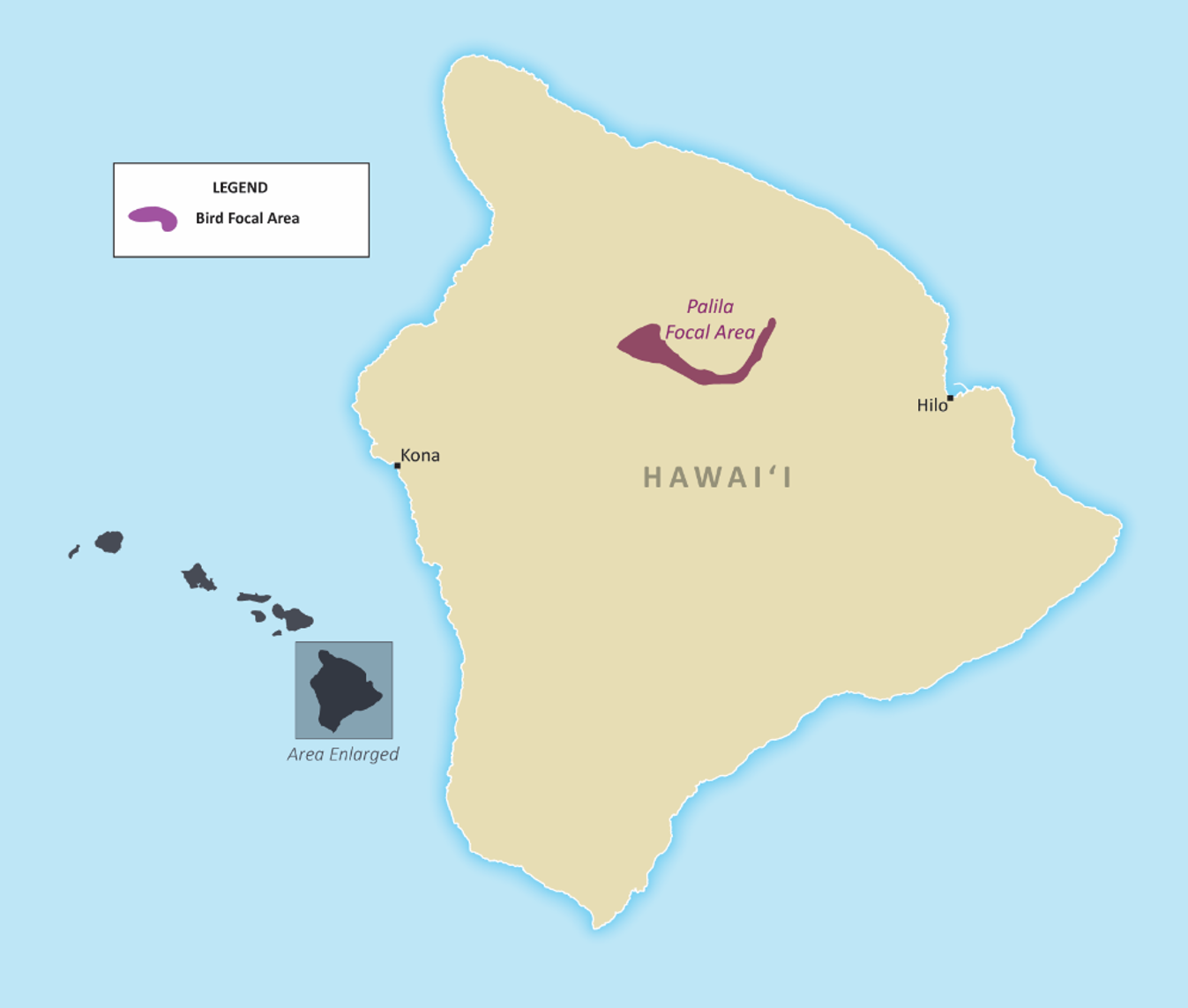
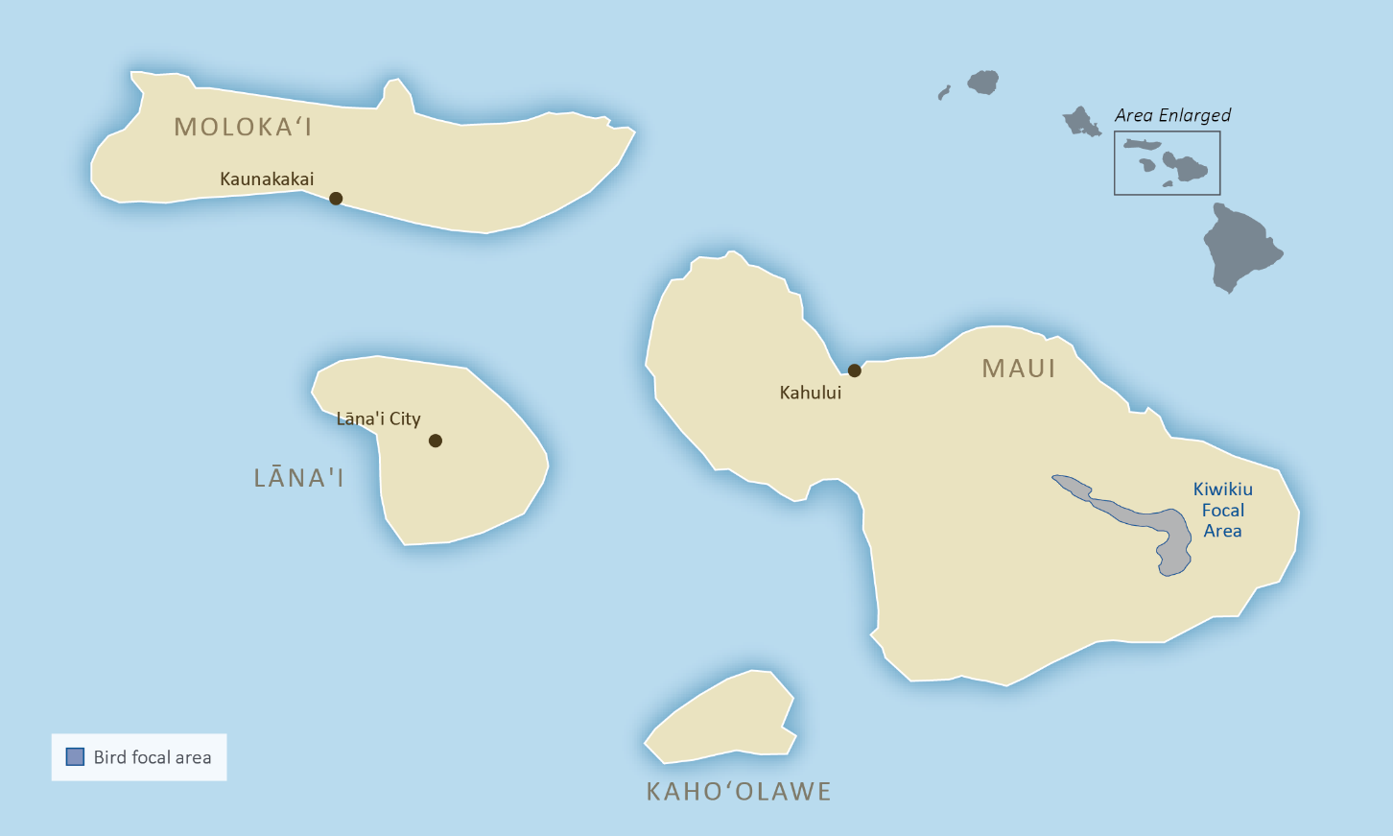
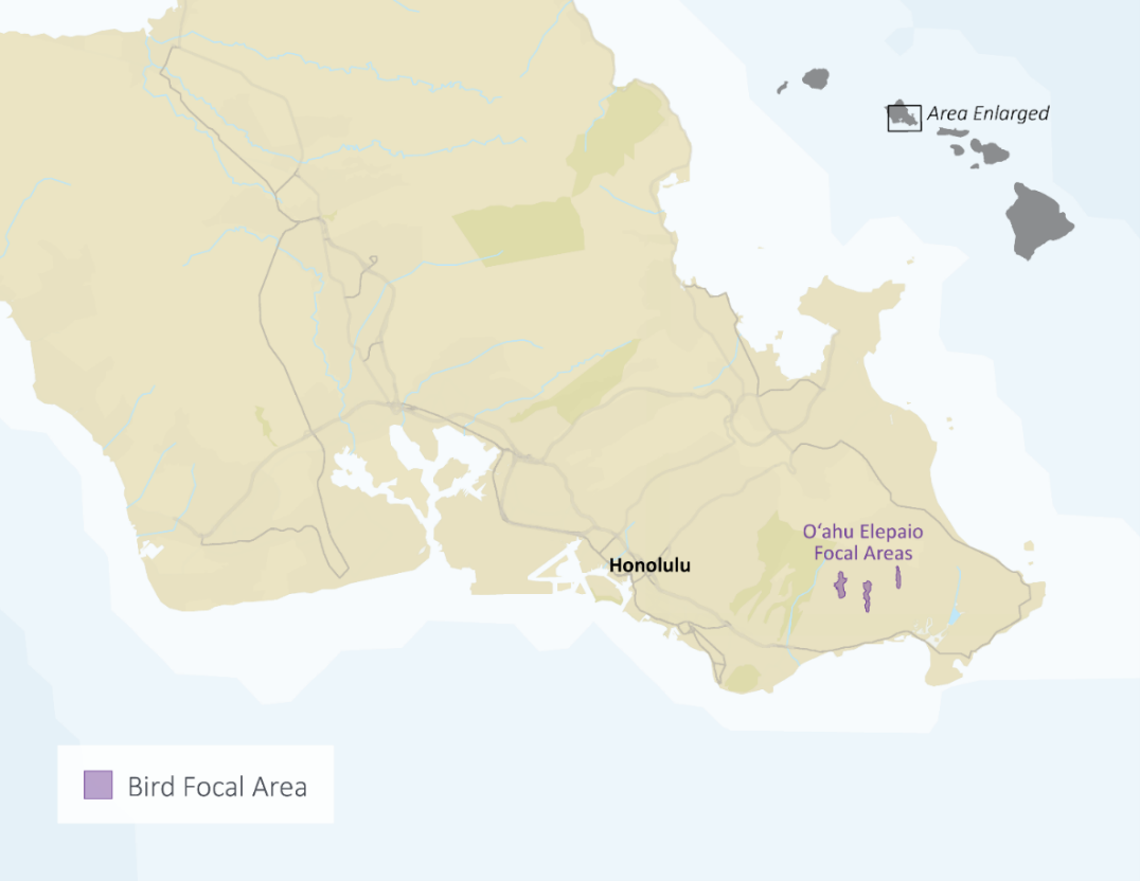
To be eligible for funding, projects must occur within the priority geographic areas illustrated in Maps 1–3 for the focal species located on Hawaiʻi Island, Maui, and Oʻahu, as well as within priority forest bird habitat on Kauaʻi and Maui for landscape-scale mosquito control to help prevent the spread of avian malaria.
PROGRAM PRIORITIES
All proposals must specifically address how projects will directly and measurably contribute to the accomplishment of one or more of the program priorities listed below and as identified in the Hawaiʻi Conservation Program Business Plan. Projects that incorporate community outreach, foster community engagement, and pursue collaborative management while elevating traditional knowledge that will lead to measurable conservation benefits are encouraged.
In 2027, the Hawaiʻi Conservation Program will award grants to projects that address the following program priorities.
Bird Conservation: Reduce extinction risk for a suite of endemic bird species by addressing direct threats and improving habitat conditions. Pervasive and ongoing threats for Hawaiian birds include avian malaria, habitat loss and degradation, and invasive predators and plants. In 2027, NFWF seeks projects that support listed birds on Kauaʻi, Oʻahu, Maui and Hawaiʻi Island with a primary emphasis on the following priorities:
- Kiwikiu – Support the kiwikiu steering committee’s efforts to address short and long-term conservation needs. Activities may include supporting captive rearing, predator control, and conducting species monitoring.
- ʻAlalā – Support the establishment of a self-sustaining population of ʻalalā on Maui and Hawaiʻi Island. Project activities may include release planning and implementation, post-release monitoring, supplemental support for released birds, and other actions necessary to advance long-term population recovery.
- Palila – Prevent extinction of palila by protecting critical habitat on Hawaiʻi Island. Project activities may include support for rear and release, predator control and ungulate control, constructing and maintaining ungulate and predator control fencing, fire management including invasive vegetation management and outplanting native plants.
- Oʻahu elepaio – Increase Oʻahu elepaio territorial occupancy. Project activities may include rodent control through trapping, predator surveys, and population monitoring.
- Landscape-scale mosquito control for endemic forest birds – Support strategies to suppress populations of the invasive southern house mosquito on Maui and Kauaʻi to reduce or eliminate the occurrence of avian malaria at a landscape-scale to prevent the extinction of endangered forest birds. Project activities may include deployment of mosquito suppression treatments, data collection and assessments to identify priority control locations, treatment effectiveness studies, mosquito surveillance and research to fill critical information gaps, coordination and planning among Birds, Not Mosquitoes partnership, and community outreach and education on the conservation need and tool(s) available.
- Integration of cultural values in Hawaiian forest bird conservation – Support the meaningful integration of Native Hawaiian cultural knowledge, values, and practices into conservation strategies for Hawaiian forest birds. Projects may include collaborative engagement with cultural practitioners, community leaders, and ʻāina-based organizations to ensure conservation approaches are guided by Indigenous perspectives. Priority will be given to efforts that work in partnership with federal and state agencies to strengthen biocultural relationships, promote cultural stewardship, and elevate traditional ecological knowledge in forest bird recovery efforts.
PROJECT METRICS
To better gauge progress on individual grants and to ensure greater consistency of project data provided by multiple grants, the Hawaiʻi Conservation Program has a list of metrics in Easygrants for full proposal applicants to choose from for future reporting. We ask that applicants select only the most relevant metrics from this list for their project (all possible program metrics are shown in the table below). If you think an applicable metric has not been provided, please contact Jana Doi (jana.doi@nfwf.org) to discuss acceptable alternatives.
| Project Activity | Recommended Metric | Additional Guidance |
| Habitat Management | # of miles of ungulate-proof fencing maintained | Enter the number of miles of ungulate-proof fencing maintained for the benefit of palila. In the metric notes section, indicate the year the miles of fence were maintained. |
| Species-specific Strategies | # of ungulates removed | Enter the number of pigs, goats, deer or other ungulates removed or controlled. In the metric notes section, indicate where the ungulates were removed from and what type of ungulate. |
| Species-specific Strategies | # of individuals removed | Enter the number of individual invasive animals or predators (cats, mongoose, and rodents) removed. If removing ungulates, please use metric # of ungulates removed. In the metric notes section, indicate where the invasive animals were removed from and what type of animal. |
| Species-specific Strategies | # of individuals captured | Enter the number of individual birds captured for establishing a captive population. In the metric notes section, indicate the species captured. |
| Species Outcome | # of populations established | Enter the number of captive bird populations established. In the metrics notes section, specify the species of bird. |
| Species-specific Strategies | # individuals released | Enter the number of individual birds released into the wild. In the metric notes section, indicate the species released. |
| Habitat Management | # of lbs sediment avoided (annual) | Enter the number of pounds of sediment discharge (lbs/year) reduced. In the metric notes section, specify the reef tract that this metric is supporting and describe the method used to calculate the reduction. |
| Habitat Management | # of lbs of nutrients avoided (annual) | Enter the number of pounds of nutrient discharge (lbs/year) reduced. In the metric notes section, specify the reef tract that this metric is supporting and describe the method used to calculate the reduction. |
| Habitat Management | # of acres with BMPs | Enter the number of acres with Best Management Practices (BMPs) for sediment and nutrient reduction. In the NOTES section, indicate the type of BMP(s) and the method of calculating reduction. |
| Habitat Management | # of acres under improved management through predator control | Enter the number of acres under improved management through predator control (cats, mongoose, and rodents). |
| Habitat Restoration | # of acres restored through invasive plant removal | Enter the number of acres of invasive plants removed. In the metric notes section, specify: vegetation removed (i.e. species/plant type such as broadleaf, conifers, forest understory, shrubs, kudzu/vines, and grasses/forbs), desired dominant vegetation (broadleaf, shrub, grass), average frequency (in years) of future treatment, and whether removed vegetation will be left on site to decompose (Yes/No). |
| Habitat Restoration | # native species outplanted | Enter the number of native plant species planted. In the metric notes section, indicate the species of plants planted. |
| Habitat Restoration | # of native plants outplanted | Enter the number of native plants planted. |
| Habitat Restoration | # of acres restored through native outplanting | Enter the number of acres of native plants installed. In the metric notes section, specify landcover type prior to planting (barren, cropland, grass, shrub), type of natives planted (grasses/forbs, shrubs, or broadleaf forest) and density per acre. Also include land cover post-restoration (broadleaf, conifer, redwood, grassland, shrubland, marsh, wet meadow, tidal marsh, swamp, seagrass, kelp forest). |
| Planning, Research, Monitoring | # studies used to inform management | Enter the number of studies to inform management. |
| Planning, Research, Monitoring | # monitoring programs | Enter the number of monitoring programs. In the metric notes section, describe what is being monitored, the methodology, and frequency. |
| Capacity, Outreach, Incentives | # people targeted | Enter the number of people reached by outreach, training, or technical assistance activities. In the metric notes section, describe the type(s) of outreach and how the outreach contributes to conservation activities. Metric notes should include information as to how people were reached (i.e. community meetings, workshops, volunteer events, etc). If using this metric, please also use the "# people with changed behavior" metric. |
| Capacity, Outreach, Incentives | # people with changed behavior | Enter the number of people demonstrating a minimum level of behavior change. This metric should be used to capture people that have been reached, and as a result are applying gained knowledge. Examples include implementing a conservation practice or entering into a partnership that will promote conservation efforts. If using this metric, please also use the "# people reached" metric. |
| Capacity, Outreach, Incentives | # of volunteers participating in projects | Enter the number of volunteers that participated in the project. In the metric notes section, indicate the events or activities volunteers participated in. |
| Capacity, Outreach, Incentives | # of volunteer hours | Enter the number of volunteer hours completed through the project. In the metric notes section, indicate the events or activities volunteers participated in.
|
ELIGIBILITY
Eligible and Ineligible Entities
- Eligible applicants include non-profit 501(c) organizations, U.S. Federal government agencies, state government agencies, local governments, municipal governments, Tribal Governments and Organizations, educational institutions, and businesses.
- Ineligible applicants include international organizations and unincorporated individuals.
- For-profit applicants: Please note that this is a request for grant proposals, not a procurement of goods and services; see the Budget section below for specific cost considerations.
EVALUATION CRITERIA
All proposals will be screened for relevance, accuracy, completeness and compliance with NFWF and funding source policies. Proposals will then be evaluated based on the extent to which they meet the following criteria.
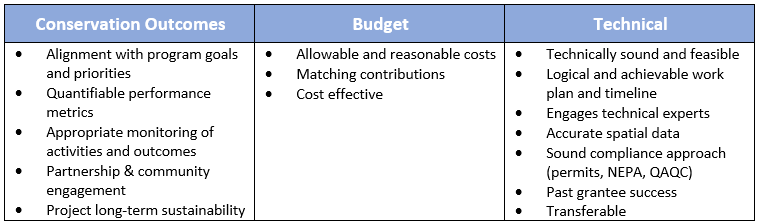
Partnership and Community Impact – The applicant organization partners and engages collaboratively with local community members, leaders, community-based organizations, and other relevant stakeholders to develop and implement the proposed project. This ensures long-term sustainability and success of the project, integration into local programs and policies, and community acceptance of proposed restoration actions. Partners or communities are enlisted to broaden the sustained impact from the project. Describe the community characteristics of the project area, identify any communities impacted, describe outreach and community engagement activities and how those will be monitored and measured. Use data to support descriptions and submit letters of support from community partners and/or collaborators demonstrating their commitment to the project and engagement in project activities as proposed.
Budget – Costs are allowable, reasonable and budgeted in accordance with NFWF’s Budget Instructions cost categories. Federally-funded projects must be in compliance with OMB Uniform Guidance as applicable.
Matching Contributions – Matching Contributions consist of cash, contributed goods and services, volunteer hours, and/or property raised, spent, and acquired for the Project during the Period of Performance. Larger match ratios and matching fund contributions from a range of partners are encouraged and will be more competitive during application review.
Cost-Effectiveness – Cost-effectiveness analysis identifies the economically most efficient way to meet project objectives. Project includes a cost-effective budget that balances performance risk and efficient use of funds. Cost-effectiveness evaluation includes, but is not limited to, an assessment of effective direct/indirect costs across all categories in the proposed budget according to the type, size and duration of the project and project objectives. Project budgets will be compared to similar projects to ensure proposed costs across all budget categories are reasonable for the activities being performed and the outcomes proposed.
Spatial Data – Project spatial data submitted to NFWF’s online mapping tool accurately represent the location(s) of conservation activity(ies) at the time of proposal submission. Successful projects will be required to submit improved spatial data for each conservation activity within the period of performance as necessary.
OTHER
Ineligible Uses of Grant Funds
- NFWF funds and matching contributions are strictly prohibited from being used for a number of reasons to include, for example, political advocacy, fundraising, lobbying, litigation, terrorist activities, or in violation of the Foreign Corrupt Practices Act. See OMB Uniform Guidance for additional information.
- Equipment: Applicants are encouraged to rent equipment where possible and cost-effective or use matching funds to make those purchases. NFWF acknowledges, however, that some projects may only be completed using NFWF funds to procure equipment. If this applies to your project, please contact the program staff listed in this RFP to discuss options.
- Pursuant to the American Security Drone Act (ASDA), effective December 22, 2025, applicants proposing activities funded in whole or in part with federal funds may not use, operate, or purchase any drone or uncrewed aerial systems (UAS) included on the Covered Foreign Entities (CFE) List. This prohibition applies to both new purchases and continued use of existing UAS, including certain widely used commercial platforms, such as DJI and Autel. Applicants are responsible for ensuring that all proposed and existing UAS used in connection with federally funded activities comply with applicable federal law and are not included on the CFE List. Noncompliance may affect eligibility for funding.
- Federal funds and matching contributions may not be used to procure or obtain equipment, services, or systems (including entering into or renewing a contract) that uses telecommunications equipment or services produced by Huawei Technologies Company or ZTE Corporation (or any subsidiary or affiliate of such entities) as a substantial or essential component, or as critical technology of any system. Refer to Public Law 115-232, section 889 for additional information.
- NFWF funds may not be used to support ongoing efforts to comply with legal requirements, including permit conditions, mitigation and settlement agreements. However, grant funds may be used to support projects that enhance or improve upon existing baseline compliance efforts.
Environmental Services – NFWF works with partners to foster sustainable and impactful conservation solutions so that people and nature thrive together. NFWF recognizes that some benefits from projects may be of value with regards to credits on an environmental services market (such as a carbon credit market). NFWF does not participate in, facilitate, or manage an environmental services market nor does NFWF assert any claim on such credits.
Intellectual Property – Intellectual property created using NFWF awards may be copyrighted or otherwise legally protected by award recipients. NFWF may reserve the right to use, publish, and copy materials created under awards, including posting such material on NFWF’s website and featuring it in publications. NFWF may use project metrics and spatial data from awards to estimate societal benefits that result and to report these results to funding partners. These may include but are not limited to: habitat and species response, species connectivity, water quality, water quantity, risk of detrimental events (e.g., wildfire, floods), and carbon accounting (e.g., sequestration, avoided emissions).
Procurement – If the applicant chooses to specifically identify proposed Contractor(s) for Services, an award by NFWF to the applicant does not constitute NFWF’s express written authorization for the applicant to procure such specific services noncompetitively. When procuring goods and services, NFWF award recipients must follow documented procurement procedures which reflect applicable laws and regulations.
Publicity and Acknowledgement of Support – Award recipients will be required to grant NFWF the right and authority to publicize the project and NFWF’s financial support for the grant in press releases, publications and other public communications. Recipients may also be asked by NFWF to provide high-resolution (minimum 300 dpi) photographs depicting the project.
Receiving Award Funds – Award payments are primarily reimbursable. Projects may request funds for reimbursement at any time after completing a signed agreement with NFWF. A request of an advance of funds must be due to an imminent need of expenditure and must detail how the funds will be used and provide justification and a timeline for expected disbursement of these funds. Requests for monthly advances will not be considered.
Compliance Requirements – Projects selected may be subject to requirements under the National Environmental Policy Act, the Endangered Species Act (state and federal), and the National Historic Preservation Act. Documentation of compliance with these regulations must be approved prior to initiating activities that disturb or alter habitat or other features of the project site(s). Applicants should budget sufficient time and resources to obtain the needed approvals. As may be applicable, successful applicants may be required to comply with additional Federal, state or local requirements and obtain all necessary permits and clearances.
Permits – Successful applicants will be required to provide sufficient documentation that the project expects to receive or has received all necessary permits and clearances to comply with any Federal, state or local requirements. Where projects involve work in the waters of the United States, NFWF strongly encourages applicants to conduct a permit pre-application meeting with the Army Corps of Engineers prior to submitting their proposal. In some cases, if a permit pre-application meeting has not been completed, NFWF may require successful applicants to complete such a meeting prior to grant award.
HOW TO APPLY
All application materials must be submitted online through National Fish and Wildlife Foundation’s Easygrants system.
- Go to easygrants.nfwf.org to register in our Easygrants online system. New users to the system will be prompted to register before starting the application (if you already are a registered user, use your existing login). Enter your applicant information. Please disable the pop-up blocker on your internet browser prior to beginning the application process.
- Once on your homepage, click the “Apply for Funding” button and select this RFP’s “Funding Opportunity” from the list of options.
- Follow the instructions in Easygrants to complete your application. Once an application has been started, it may be saved and returned to at a later time for completion and submission.
APPLICATION ASSISTANCE
A Tip Sheet is available for quick reference while you are working through your application.
Additional information to support the application process can be accessed on the NFWF website’s Applicant Information page.
For more information or questions about this RFP, please contact:
Jana Doi
Director, Alaska and Pacific Islands Programs
Jana.Doi@nfwf.org
(415) 243-3102
For issues or assistance with our online Easygrants system, please contact:
Easygrants Helpdesk
Email: Easygrants@nfwf.org
Voicemail: 202-595-2497
Hours: 9:00 am to 5:00 pm ET, Monday-Friday.
Include: your name, proposal ID #, e-mail address, phone number, program you are applying to, and a description of the issue.