Making room for wildlife through virtual fencing
Farmers and ranchers are often romanticized as living tranquil lives close to the land, guided by familiar rhythms and generations of tradition. The reality is far more demanding. Days are long. The work is physical. Vacations are exceedingly rare. And historically, one of the most grueling, time-consuming tasks has been managing the miles of fencing required to keep livestock where they need to be.
Traditional fencing — posts driven into the ground, wire stretched tight between them — has long dictated how cattle move, or don’t move, across a landscape. Ranchers have devoted countless hours to building and repairing fences, rotating herds to fresh pasture, and responding to fencing damage from storms, migrating wildlife or wear and tear. On large properties, that labor multiplies quickly. The bigger the ranch, the more time and manpower fencing requires, often limiting a producer’s ability to respond to changes in weather, forage availability or wildlife needs.
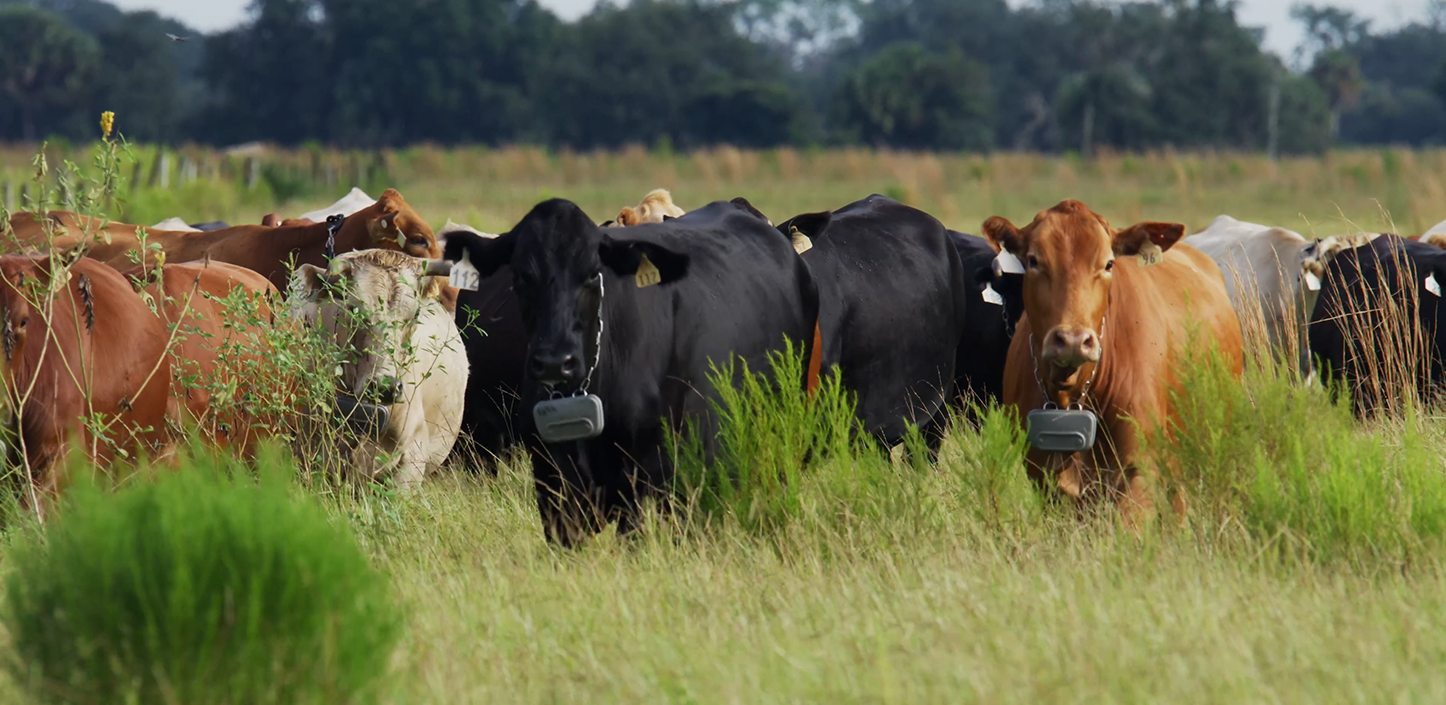
Now, a growing number of ranchers are discovering a different way forward. Technology known as “virtual fencing” replaces or augments physical barriers with digital ones, offering new opportunities for both agricultural efficiency and conservation. Instead of relying solely on post-and-wire fencing, ranchers use GPS-enabled collars fitted on livestock, a communications tower, and a computer or smartphone that allows them to draw the invisible but effective boundaries on a digital map.
When cattle, sheep or other livestock approach one of these boundaries, the collars they wear emit a sound or a stimulus, encouraging them to turn back. Over time, livestock learn to stay within designated areas, without the need for physical barriers. The result is a dramatic reduction in the labor associated with fencing and herding. Wildlife also benefits significantly: fewer fences mean fewer barriers for migrating big-game species such as elk, mule deer and pronghorn, and a reduced risk of birds striking fencing during migration.
With support from NFWF and its partners, virtual fencing projects are taking root across the country, not only helping ranchers save time and improve grazing efficiency but also benefitting wildlife and the wider ecosystem.
In Florida, Virtual Fencing Supports Conservation in the Wildlife Corridor
At Blackbeard’s Ranch in Florida, owner Jim Strickland likes to joke that every cow on his property has a cell phone.
He’s not far off. With funding from the U.S. Department of Agriculture’s Natural Resources Conservation Service (NRCS), Strickland has outfitted 125 cattle with GPS-enabled collars. The devices communicate with a tower on the ranch, tracking each animal’s location much like a smartphone would.
Blackbeard’s Ranch may be the first in Florida to adopt virtual fencing — a technology more commonly associated with the wide-open rangelands of the West. Strickland was curious whether the technology could work well in Florida, where installing traditional fencing in dense vegetation and wetlands can be difficult and environmentally disruptive.
That curiosity turned practical after Hurricane Ian tore through Florida in 2022, destroying nearly 18 miles of fencing on the ranch.
Rather than invest time and effort in reinstalling physical fencing, Strickland thought, “If I can get my cell phone towers back up, if the GPS is working and my cell phone towers work, I will be able to herd my cows.”
The flexibility has been transformative. With virtual fencing, Strickland says, “I can fence out wetlands, fence in wetlands by the stroke of a pen. If we have nesting areas, I can fence the cattle out. And tomorrow, I can take the fence down.”
The benefits extend well beyond convenience. Blackbeard’s Ranch sits within the Florida Wildlife Corridor, nearly 18 million acres of connected wilderness and working lands essential to the survival of many of the state’s imperiled species, including the Florida panther.
Living and working within the corridor has made Strickland see himself as both a cattleman and a conservationist. Since entering the ranch into a conservation easement with NRCS, he has worked closely with wildlife biologists to manage the land for both livestock and habitat. He has adjusted cattle-gathering schedules to avoid turkey nesting seasons and paused hunting on the property for four years to allow wildlife populations to rebound.
One morning in April 2024, while riding near the boundary of Myakka River State Park, Strickland caught a fleeting glimpse of something he had never seen before.
“I am 69 years old, and I’ve been in the woods from the Everglades to the Georgia line my entire life,” he said. “And I saw my first panther.”
In Missouri, Virtual Fencing Leads to Peace of Mind
In Missouri, virtual fencing is being tested through a three-year initiative led by the University of Missouri, supported by a $900,000 grant from NFWF through the Conservation Partners Program.
A collaboration between University of Missouri’s Virtual Fence Program and the College of Agriculture, Food and Natural Resources, the project provides technical assistance and establishes a peer-to-peer learning network among farmers to explore how virtual fencing fits into Midwestern farming systems. The idea is that virtual fencing might help land managers voluntarily implement management practices that improve soil health and address conservation goals.
So far, five livestock producers are participating. Four have collared cattle, while one has collared sheep. Feedback has been overwhelmingly positive.
“Farmers might be out multiple times a day moving their physical fences in extreme weather, so using virtual fencing can make their lives so much easier,” Kaitlyn Dozler, one of the project leads, told the Kirksville Daily Express. “One producer told me she was able to take a vacation for the first time in five years, because she knew she could just go online at any time and see exactly where her goats were.”
That peace of mind is paired with tangible gains in productivity. Chris Hudson, a farmer from Middletown, Missouri, collared 50 of his cattle and reported a dramatic jump in grazing efficiency, from about 90 grazing days per acre under traditional systems to roughly 170 days per acre using virtual fencing. This efficiency extends to croplands, which often lack the physical infrastructure for livestock. By using virtual boundaries, farmers can easily introduce cattle to graze on crop residues and cover crops, cycling nutrients back into the soil and providing additional economic benefits.
While virtual fencing isn’t designed to replace all perimeter fencing, it offers considerable advantages for rotational grazing practices and shows that this technology can complement traditional methods of land management. By removing the labor barriers to moving herds frequently, the technology allows for rotational grazing cycles that improve forage quality and soil health.
Beyond operational ease, the shift to virtual boundaries offers a lifeline to retain biodiversity in the Midwest. By removing the some of the fencing that knits together this landscape, the project facilitates safer passage for white-tailed deer and elk, and it creates movable sanctuaries for ground-nesting species like northern bobwhite and lesser prairie-chickens.
In Colorado, Virtual Fencing Clears Paths for Migrating Wildlife
Barbed wire crisscrosses Colorado’s North Park, a working landscape shaped by generations of ranching. Barbed wire can be essential tool for ranching, but it is also one that can injure, kill or block migrating wildlife such as pronghorn, elk and mule deer.
“Fencing is kind of that low-hanging fruit when it comes to obstacles that wildlife face,” said Brittany Parker, formerly with Backcountry Hunters and Anglers (BHA), “in that we are able to remove it or modify it just to improve the connectivity for wildlife movement.”
Through NFWF’s RESTORE Colorado Program, BHA was awarded a grant to remove, modify and inventory fencing that impacts wildlife movement. BHA works with ranchers in North Park like Phillip Anderson to test virtual fencing in high-priority areas.
Anderson’s ranch abuts public lands managed by the Bureau of Land Management (BLM) and the Arapaho National Wildlife Refuge (NWR). Big game species, waterfowl and other wildlife move freely across these boundaries, making collaboration among BLM, the Arapaho NWR and private landowners like Anderson essential.
“The ranchers that we work with are stewards of the land, just like we are of the refuge or the BLM,” said Keely Lopez, deputy refuge supervisor of Arapaho NWR. “And so, the wildlife habitat that exists here in North Park isn’t just on the refuge — it’s on these private lands [and] on the BLM.”
By adopting virtual fencing, Anderson can move cattle quickly and precisely, even from miles away.
“I can be in Laramie, and I can see where my cows are. I could be probably in Chicago and see where my cows are,” Anderson said in a recent interview with NPR. “That’s a kind of a neat deal.”
That flexibility matters in a harsh landscape like North Park, where wildfire, drought and migration patterns can shift rapidly. Virtual fencing allows Anderson to funnel cattle out of danger during emergencies and reduce physical barriers in areas critical for wildlife movement.
While traditional fencing still plays a role, especially near roads and the federal lands that require it, virtual fencing offers a way to balance livestock management with ecological health. It allows Anderson to target grazing more precisely, creating greater variation in grass height and structure across the landscape, which supports a healthier, more diverse ecosystem.
Anderson believes that ranchers like himself are interested in “making sure that their families are going to be able to continue on that property over the next 10 or 15 generations.” But innovations like virtual fencing don’t have to come at the expense of tradition.
As Anderson puts it, “We just hope people are patient enough, including the producers, that as change happens, we are willing to look at it and see what works [and] throw away what doesn’t.”
Contributing Partners: Bureau of Land Management, Colorado Department of Natural Resources, U.S. Environmental Protection Agency, U.S. Fish and Wildlife Service, U.S. Forest Service, USDA Natural Resources Conservation Service, Bezos Earth Fund, Gates Family Foundation, Great Outdoors Colorado, Trinchera Blanca Foundation, Walton Family Foundation, Cargill, Chevron, General Mills, Nestle, Occidental, The J.M. Smucker Co.