Using sound to restore degraded coral reefs in Hawai‘i
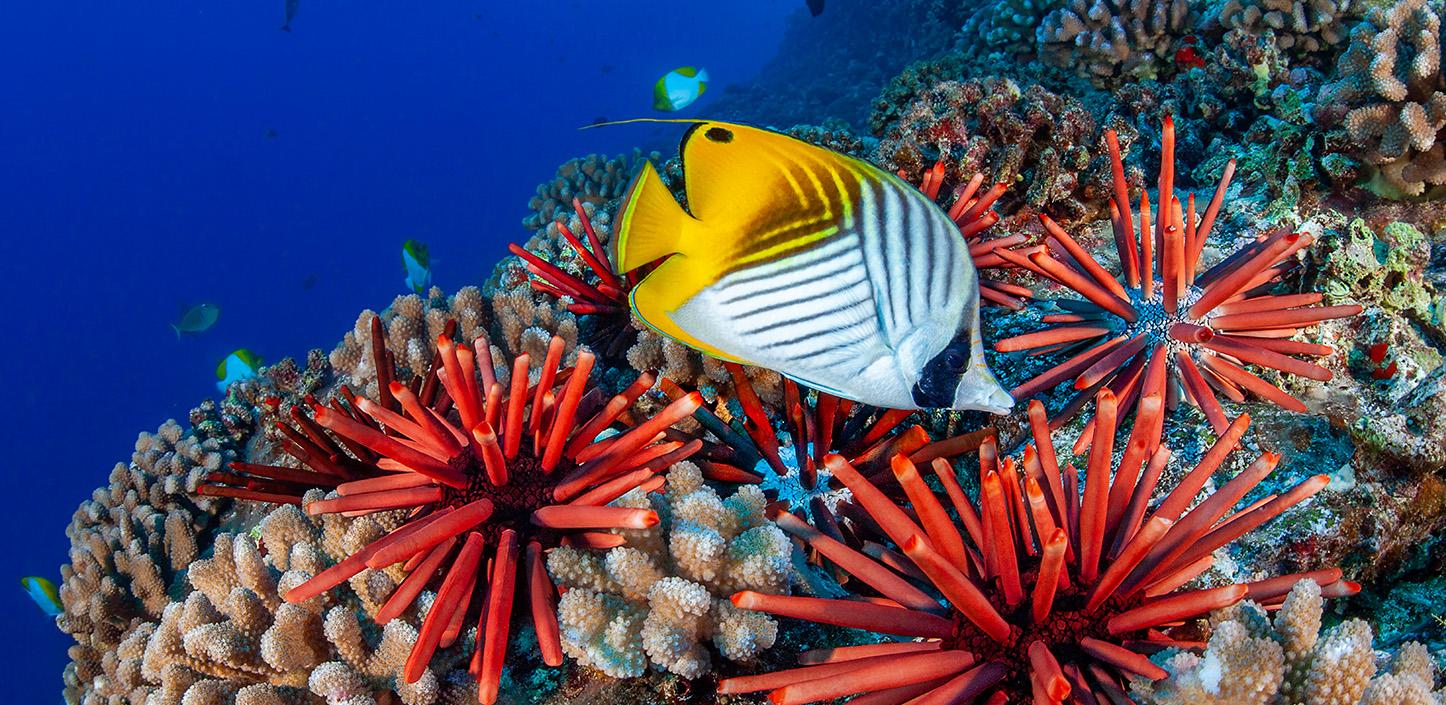
You might not think of the ocean floor as a place that is bustling with noise. But to those who listen closely, the seafloor is alive with crackles, chirps and pops.
“A healthy reef is really just vibrant with sounds,” explains T. Aran Mooney, who leads the Sensory Ecology and Bioacoustics Lab at Woods Hole Oceanographic Institution (WHOI) in Massachusetts. “You can actually hear fish calling to each other... parrotfish scraping on the reef or attracting mates or defending territories,” Mooney said in a recent segment of CNN’s Call to Earth.
Coral reefs are among the world’s most ecologically, economically and culturally valuable ecosystems. These reefs are hubs of marine biodiversity, provide ecosystem services to coastal areas, and support industries that are vital to coastal communities such as fisheries and tourism. Yet 58 to 70 percent of reefs globally are threatened by overfishing, heavy boat use, and pollution from land-based runoff that weaken reef systems and reduce their ability to withstand environmental stress. These stressors lead to increasingly frequent mass-bleaching events all over the world.
To help revive struggling reefs, Mooney and a team at WHOI are experimenting with sound, supported by a grant from the Coral Reef Stewardship Fund, which is a public-private partnership between the National Fish and Wildlife Foundation and NOAA, USDA’s Natural Resources Conservation Service and Aramco Americas. The team’s research tests whether the sounds of a healthy reef can attract coral larvae to damaged areas and accelerate recovery.
“We started listening to reefs in the Virgin Islands around 2012,” Mooney recalls. “The focus of that was how to really understand or use sound to measure the health of reefs.” Healthier reefs, his team found, supported more diverse fish communities and richer, more complex soundscapes.
Testing Sound as a Restoration Tool in Hawai‘i
In recent months, Mooney’s team has conducted a field experiment off the coast of Maui, Hawai‘i. This time, they aren’t just listening; they’re broadcasting their own symphony of reef sounds onto degraded areas.
“When you lose these reefs, you begin to kind of lose the vibrancy, the sound cues or the sense that might attract those baby fish and baby corals back to the reefs,” Mooney says.
A study based in the U.S. Virgin Islands previously showed that coral larvae were significantly more likely to settle when healthy reef sounds were played underwater. Settlement rates increased up to sevenfold.
Building on that work, the team developed the Reef Acoustic Playback System (RAPS), an underwater device that plays recordings of healthy reefs. The team ran the RAPS systems in the afternoon and through the night, when coral larvae are more likely to select settlement sites. Different coral species respond to sound cues in various ways, but many appear sensitive to the low-frequency vibrations emitted by vibrant reefs.
In Maui, Mooney and his team set out to learn whether Pacific corals react to reef sounds the same way Caribbean corals do, or if each coral region has its own “local dialect,” as Mooney told CNN. In other words, do Maui corals need Maui specific soundscapes, or will any vibrant, healthy reef soundtrack help spur settlement? The team also examined which species are the most responsive to sound to guide future restoration work.
To test this, the team set up two underwater sites, one with a RAPS speaker playing healthy reef recordings and another with a silent “dummy” speaker. At each site, they placed stone tiles at different distances to see where coral larvae chose to attach. After collecting the tiles, the team examined how many larvae settled at each location to measure whether reef soundscapes could meaningfully boost coral settlement.
Coral larvae have only a brief window to choose where they will attach and metamorphose into adults. Because adult corals are immobile, this early decision is critical. Soundscapes play a key role in signaling where good habitat may exist.
Back at the Maui Ocean Center Lab, the team spent weeks examining all 240 tiles under microscopes and UV light, documenting not only coral larvae but also the other organisms hitching a ride on the tiles.
“Another cool thing we can actually measure is the community that shows up,” Mooney says. “The sponges or oysters that settle alongside corals.”
While the early results showing increased settlement are encouraging, Mooney stresses that much remains to be learned.
“Restoration of reefs is going to require a lot of different solutions, and reefs are different around the world,” Mooney says. “There's other components than the ocean, of course, that we need to think about. But we do think we have a pretty interesting solution here. One of them is using natural sound out there.”