Turning down the volume for Southern Resident killer whales
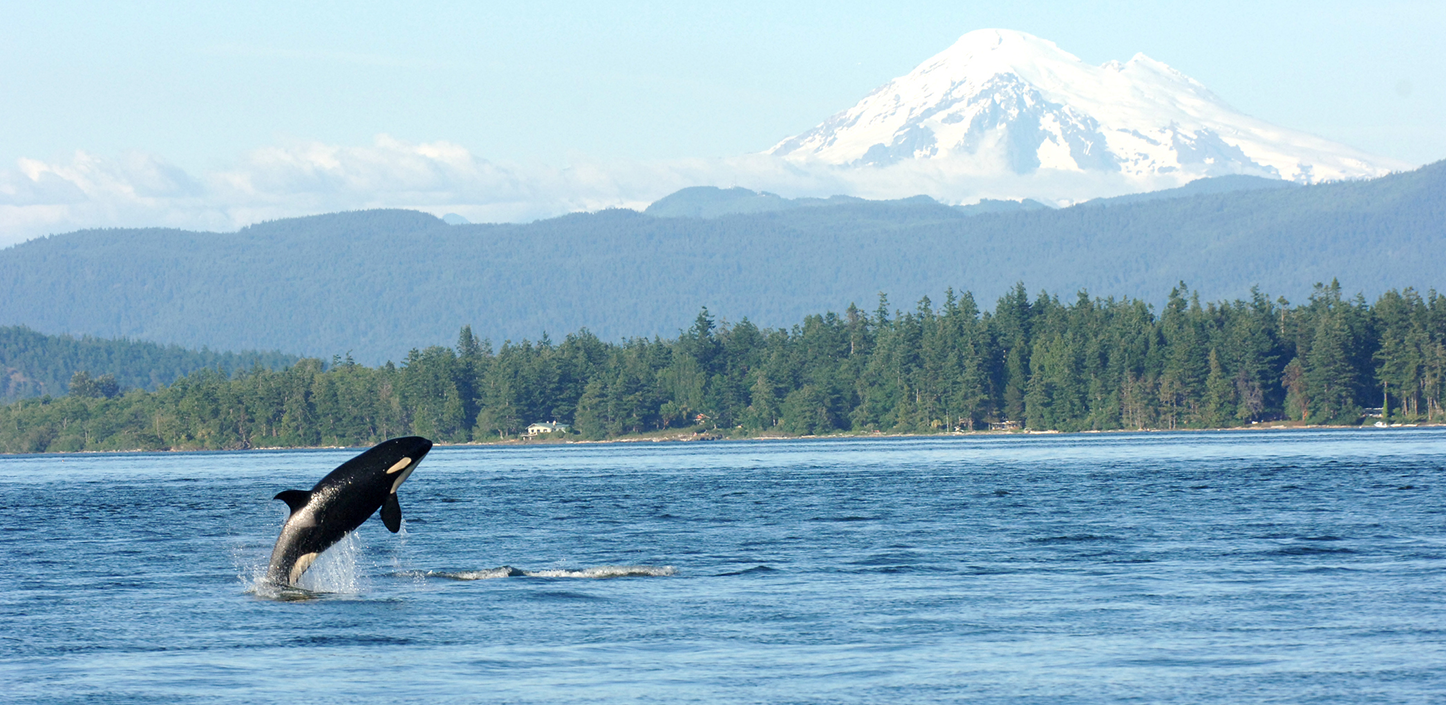
Just as killer whales are woven into the cultures of Washington’s coastal communities, the Southern Resident killer whales that swim in the Pacific Northwest’s waterways have a culture of their own. They travel in close family groups, called pods, each with a distinct repertoire of calls, passed down through generations and distinct from that of other killer whales in the region. They also use echolocation, listening for returning echoes, to find prey in dark or murky water. And unlike the region’s Bigg’s killer whales, which hunt marine mammals, Southern Residents feed primarily on fish, specifically Chinook salmon.
But the whales do not have this acoustic landscape to themselves. The Salish Sea, which encompasses Puget Sound and inland waters spanning the U.S.-Canada border, is both an ecosystem and a major transportation corridor, with shipping lanes serving the ports of Seattle, Tacoma, Everett and Vancouver, British Columbia. And it’s noisy: the din from ships can mask the sounds the whales need to hunt and communicate. Research has found that Southern Residents raise their voices as background noise increases, much as a person might shout over a passing train.
A 2024 study of Northern and Southern Resident killer whales found that, for every 1-decibel increase in maximum noise level, females had 58 percent lower odds of pursuing prey, and whales of both sexes had 12.5 percent lower odds in capturing prey.
That matters for a population of about 75 whales. “When it’s loud underwater, it gets harder for [Southern Resident killer whales] to find food,” Rachel Aronson, program director of Quiet Sound and a NFWF grantee, recently told CNN. “Sometimes they will hunt and miss, so they’ve expended energy but gotten nothing back. Sometimes they just forgo hunting, which is a problem, especially if they’re a female who is building up to a pregnancy or nursing a baby.”
With support from a series of NFWF grants, Quiet Sound, a program of Washington Maritime Blue, is expanding real-time whale alerts, advancing voluntary vessel slowdowns and developing new ways to detect whales at night and in poor weather. Together, the projects are helping maritime commerce and whale conservation coexist in one of the nation’s busiest and most ecologically important waterways.
Working with mariners in a noisy landscape
In Washington State, it’s estimated that as much as 40 percent of jobs are in some way connected to international trade, making collaboration with the maritime and shipping industries on conservation efforts essential. Quiet Sound is addressing the threats to Southern Residents by bringing mariners into the fold, developing voluntary, science-based best practices that shipping companies can build into their operations.
In October 2022, Quiet Sound launched a campaign to promote a voluntary slowdown across vital Southern Resident critical habitat.
During the first 80-day slowdown, 70 percent of the 670 vessel transits reduced their speeds, and 53 percent met the program’s requested speed targets. Southern Residents were present on 45 percent of those days. According to Quiet Sound’s reporting, median underwater sound levels declined by 2.8 decibels, representing a 45 percent reduction in sound intensity. Importantly, Quiet Sound reported that the slowdown produced the noise reduction with minimal disruption to maritime trade and no impacts to maritime safety.
The Quiet Sound program is also working to give mariners better tools and data to track the real-time presence of whales in these waterways. One of NFWF’s first grants to Washington Maritime Blue helped improve the Whale Report Alert System, or WRAS. WRAS compiles verified whale detections and delivers location alerts to commercial mariners. Quiet Sound partnered with Orca Network and Ocean Wise to add more verified real-time sightings, and the project produced roughly ten times as many alerts issued to mariners compared with the prior year, demonstrating a substantial improvement in mariner awareness of whales in Washington waters.
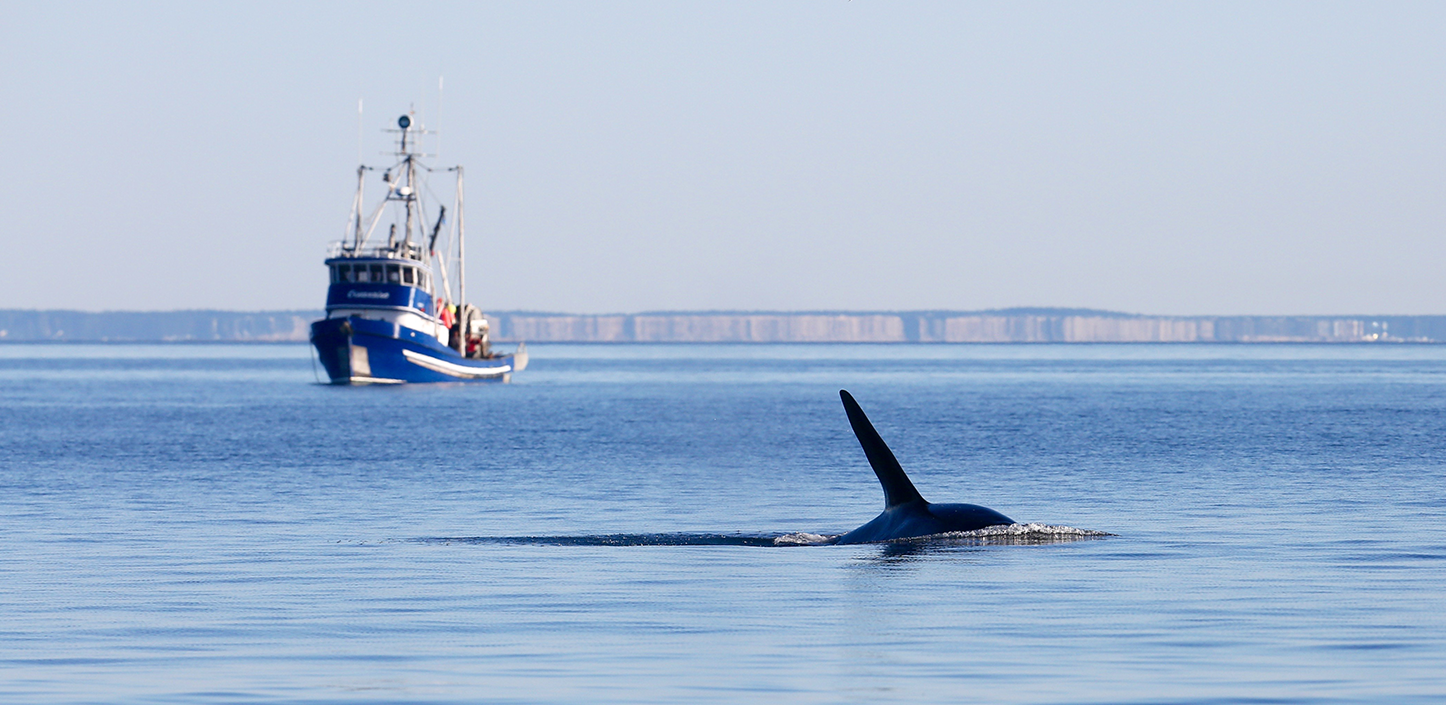
But visual sightings have limits. From the bridge of a ship, whales can be hard to spot. A dorsal fin may break the surface for only seconds, and at night or in fog, rain or rough seas a whale may pass unseen.
With additional NFWF support, Quiet Sound is working to deploy a long-term whale detection station in Puget Sound. This station will comprise a hydrophone, or underwater microphone, to detect whale calls in low-visibility conditions and transmit near-real-time information for inclusion in WRAS, and a thermal-visual camera that can see whales 24/7. With the right technology and rapid analysis, these detections above and below the water can alert commercial mariners that whales are nearby, giving ships time to slow down, adjust course or take other protective measures when safe and operationally feasible.
The Salish Sea will never be silent, but Quiet Sound’s efforts to promote better detection and quieter vessel operations could preserve more of the acoustic space Southern Residents need to find prey and stay connected to their families.
“These animals mean so much to our culture here in the Pacific Northwest,” said Aronson. “If we can prove this works here, then these same methods and tools can be deployed elsewhere to protect our oceans.”
Learn more about NFWF’s Killer Whale Conservation Program.