Restoring eastern hellbenders to southwest Virginia streams
Virginia Tech scientists, supported by the National Fish and Wildlife Foundation and partners, are piloting innovative strategies to stabilize a species on the brink.
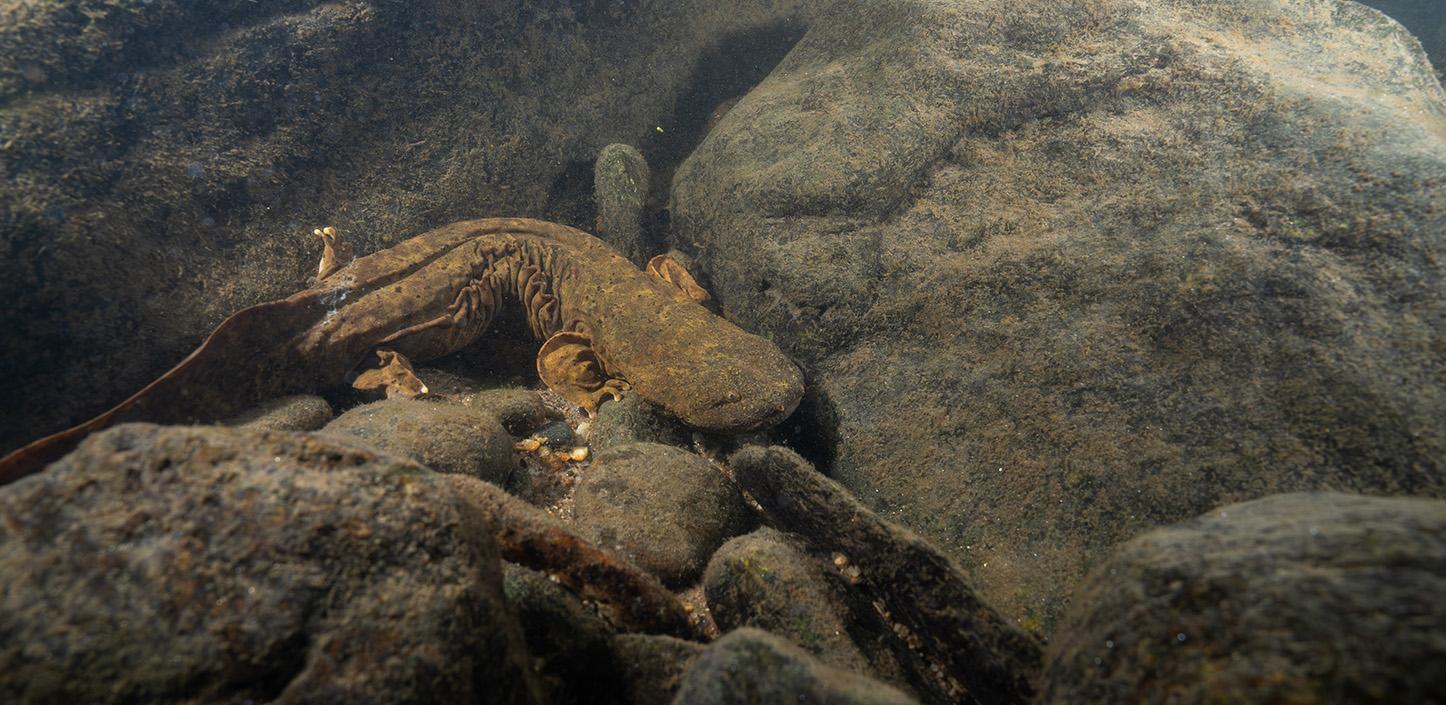
Although eastern hellbenders are the largest salamander in the United States, they can be hard to spot. These amphibians spend most of their time under flat rocks and boulders in streambeds, watching for crayfish, tadpoles, toads and water snakes. The water moves fast, but the hellbenders don’t travel far. One hellbender can sometimes be found under the same rock, year after year.
But after Hurricane Helene tore through the southeastern United States in 2024, hellbender habitats in the Clinch and Holston watersheds in southwestern Virginia were hit hard by extreme flooding, with nests washed away or destroyed by floodwaters, boulders and sediment. While some fish populations seem to have weathered Helene, scientists say hellbenders did not fare as well because the storm hit during an unfortunate time: right in the middle of their breeding season.
Even before the hurricane, hellbenders faced many challenges: loss of forest buffers, declining water quality and human disturbance. They are also prone to “filial cannibalism,” where males eat their own eggs—a behavior that increases in degraded habitats when males abandon nest-guarding duties. Already listed as a species of “critical conservation need” in Virginia’s wildlife action plan, their survival following Helene is even more uncertain.
A recent $380,000 grant awarded through NFWF’s Central Appalachia Habitat Stewardship Program aims to bring together scientists, private landowners, and the state conservation agency to help hellbenders and address chronic nest failure. Virginia Tech’s College of Natural Resources and Environment is leading the effort using a “head-starting” approach by collecting eggs from at-risk hellbender nests, raising the larvae in captivity and then releasing them in nest boxes back into their native streams.
By protecting eggs and juveniles during their most vulnerable stage, this head-starting approach gives hellbenders a better chance to recover while the team plans longer-term ecological restoration efforts, such as planting riparian buffers and implementing best land management practices.
“We have reached a critical juncture where hellbender populations have declined to the point that their future is highly vulnerable to disruptive events like Hurricane Helene,” said William Hopkins, professor in the VA Tech’s Department of Fish and Wildlife Conservation and one of the project leads. “A single storm or accidental chemical spill can wipe out small populations, so we need to take action to prevent local extinctions.”
Hellbenders are important indicators of overall ecosystem health because they perform respiration through capillaries in their skin, which makes them particularly vulnerable to water pollution. A healthy hellbender population signals good water quality and usually means that other species such as trout and freshwater mussels are also doing well.
“Importantly, the long-term vision for our work is to restore water quality in streams so that it supports both societal needs and the incredible freshwater biodiversity of this region, which includes hellbenders,” said Hopkins.
Because hellbenders have a lifespan in the wild of more than 30 years and reproduce later in life, it may take years for their numbers to recover. Hopkins and his research team believe most of the 60 hellbender nests they had been monitoring prior to Hurricane Helene were probably wiped out by the storm.
“It’s a really scary time for hellbenders and also an exciting time because we’ll be able to study them more,” said Hopkins. “We have a chance at saving a species that’s disappearing.”