West Mojave Landscape Resilience and Desert Tortoise Recovery Partnership 2026 Request for Proposals
RFP GUIDANCE
NFWF is committed to operating in full compliance with all applicable laws, regulations, and Executive Orders. We continuously monitor legal and regulatory developments to ensure our policies, procedures, and operations align with current federal directives. We encourage all applicants to do the same.
The ability and extent to which NFWF is able to make awards is contingent upon receipt of funds from federal agencies and/or other funding partners. Final funding decisions will be made based on the applications received and the level and timing of funding received by NFWF.
TIMELINE
Dates of activities are subject to change. Please revisit this page as needed for the most current dates and information.
| Applicant Webinar View Recording | March 12, 2026, 11:00-12:30pm, Pacific Time |
| Full Proposal Due Date | May 7, 2026, 11:59pm, Eastern Time |
| Review Period | May – August 2026 |
| Awards Announced | August – September 2026 |
INTRODUCTION
The National Fish and Wildlife Foundation (NFWF) is requesting proposals in two categories addressing critical conservation needs in California’s West Mojave Desert:
Category 1: Landscape Resilience grants
Category 2: Mojave Desert Tortoise Recovery and Sustainment Partnership (RASP) grants
Requirements for applications to each category are described separately below.
CATEGORY 1: LANDSCAPE RESILIENCE
OVERVIEW: CATEGORY 1 LANDSCAPE RESILIENCE GRANTS
Landscape Resilience grants will develop and implement landscape resilience projects supporting watershed and ecosystem function within or adjacent to the Marine Corps Air Ground Combat Center (MCAGCC) Twentynine Palms, California. The overarching objective of this initiative is to use Natural Infrastructure (NI) to directly benefit MCAGCC Twentynine Palms’s military training mission by protecting military readiness, natural and cultural resources, and built infrastructure from vulnerabilities related to natural hazards. NI leverages natural processes and ecosystem services to support resilience goals, such as reducing damage from floods and sustaining long-term water security.
Projects should advance approaches that align with goals of the Mojave Desert Sentinel Landscape (https://sentinellandscapes.org/landscapes/mojave-desert) and the State of California’s relevant conservation and NI efforts.
GRANT AWARD INFORMATION: CATEGORY 1 LANDSCAPE RESILIENCE GRANTS
Typical grant awards will range from $200,000 to $1,500,000 depending on the specific project activities or overall scale of projects. The Program Priorities section below, and/or the Budget section of the application, may provide further guidance on competitive grant ranges based on activity. Applicants considering proposals outside of this funding range are encouraged to contact application assistance points of contact listed below prior to submitting.
GEOGRAPHIC FOCUS: CATEGORY 1 LANDSCAPE RESILIENCE GRANTS
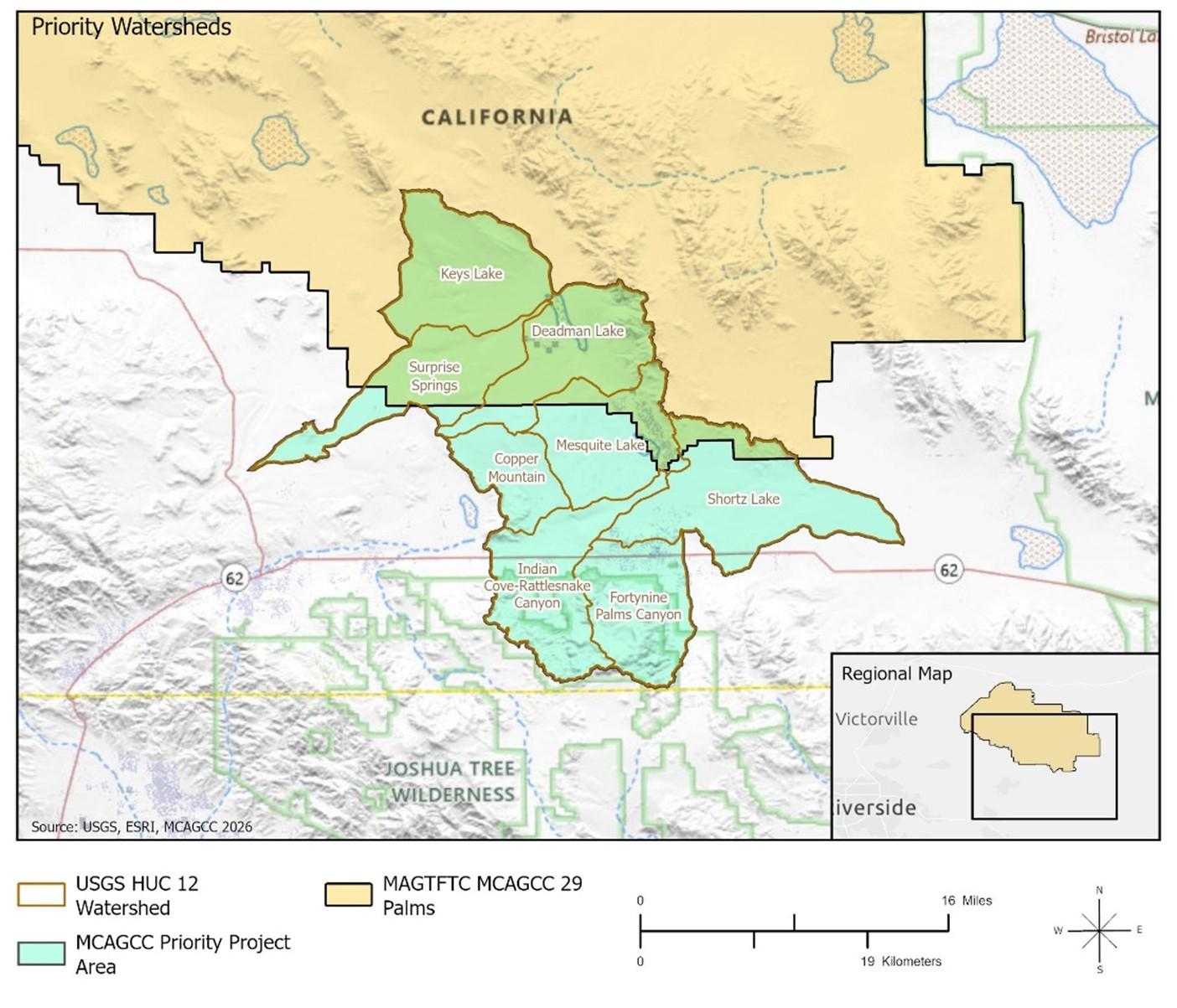
Landscape resilience projects should directly benefit Marine Corps mission resilience and be located within the MCAGCC Twentynine Palms Priority Area (Figure 1) with the potential to scale within the Mojave Desert Sentinel Landscape.
MCAGCC Priority Area can be viewed on NFWF’s GIS web portal.
PROGRAM PRIORITIES: CATEGORY 1 LANDSCAPE RESILIENCE GRANTS
Projects that address one or more of the following priorities will be most competitive for funding: 1) projects that use NI to reduce risk to military mission; 2) projects that restore watershed and landscape function; and/or 3) projects that benefit species and habitat. Applicants are strongly encouraged to highlight areas of their proposed work that are scalable, cost-effective, and collaborative. Project outcomes should demonstrate management approaches or restoration of natural systems that decrease risks to military infrastructure from natural hazards, increase water security, and improve habitats such as mesquite dunes and washes for native species including desert bighorn sheep, Joshua tree, and Mojave desert tortoise.
Applicants are encouraged to submit project ideas that are innovative and seek to re-shape our thinking on using NI to cost-effectively reduce risk to military mission, specifically:
- Mission Benefit: Projects will be prioritized for ultimate need and benefit to military training and readiness, considering long-term sustainment of critical infrastructure to, from, and on the base, providing more effective water management to protect infrastructure and recharge aquifers, and reducing maintenance costs.
- Scalability: Projects will be prioritized that are scalable, transferable, and offer the potential to catalyze further risk reduction opportunities at other installations, ranges, defense communities and federally managed lands (i.e., there is high likelihood of success that projects implemented at the MCAGCC Twentynine Palms Priority Area can be deployed elsewhere with similar beneficial outcomes).
- Cost-Effectiveness: Projects will be prioritized that include specific plans for collecting and reporting cost-benefit data to support scaling considerations within the MCAGCC Twentynine Palms Priority Area and Mojave Desert Sentinel Landscape.
Priority Category 1 Landscape Resilience activities include:
Use NI for risk reduction – Leverage natural systems and processes (i.e., physical interventions and land management approaches) to reduce current and projected natural hazard threats to military assets and infrastructure. High priority hazard mitigation areas include those experiencing ephemeral flooding, drought, wildland fire, and land degradation. Suites of NI solutions may include but are not limited to implementing stormwater management, capture and infiltration features, stormwater detention basins, check dams, dust mitigation measures, native vegetation restoration, and other resource management techniques. For additional information on NI supporting the military mission, please see: Engineering With Nature: natural infrastructure for mission readiness at U.S. Navy and Marine Corps installations (https://dx.doi.org/10.21079/11681/49461).
Restore watershed and landscape function for water security – Demonstrate and test techniques to improve watershed and landscape function through water, soil, and vegetation management. Reduce flooding and fire risk by increasing water infiltration, absorption and groundwater recharge while improving long-term water security and drought resilience (via artificial or natural recharge). Support potential for watershed and landscape scale solutions through identifying high-impact demonstration/testing sites.
Provide co-benefits to species and habitat – Improve habitats for fish and wildlife species to ensure mission operations remain uninterrupted. Proposals should be as specific as possible in identifying the anticipated benefits, and potential timelines of those benefits, to habitats and species (e.g., desert bighorn sheep, Joshua trees, and Mojave desert tortoise). Activities may also increase water and forage availability for species and their habitats. Actions that provide ecosystem services as co-benefits such as pollinator and insect availability, forb and shrub biomass, alternative prey populations, and perched or raised water tables are also pertinent.
PROJECT METRICS: CATEGORY 1 LANDSCAPE RESILIENCE GRANTS
To better gauge progress on individual grants and to ensure greater consistency of project data provided by multiple grant projects, NFWF has a list of metrics in Easygrants for full proposal applicants to choose from for reporting (commonly used metrics are shown in the table below). We ask that you select the most relevant metrics from this list for your project. As we are seeking innovative approaches, if there are not applicable metrics provided, please include a section in your proposal on potential project metrics and monitoring criteria.
| Project Activity | Recommended Metric | Additional Guidance |
| Comply with state and federal data collection and management standards | Planning, Research, Monitoring – Monitoring – # of studies whose findings are reported to management | Enter the number of datasets or monitoring reports produced and entered into relevant databases. Describe each reported dataset and/or study in the metric notes. |
| Riparian restoration | Habitat Restoration - Riparian restoration - Acres restored | Enter # of riparian acres restored, including riparian buffers to benefit native riparian vegetation and federally protected birds. In NOTES section, specify landcover type prior to planting (barren, cropland, grassland), dominant vegetation being planted (Broadleaf, Conifer, Shrub, Grass, Marsh, Wet meadow, Swamp), and average width of riparian buffer. |
| Best management practices (BMP) implementation for stormwater and sediment transport reduction | Habitat Management - BMP implementation for stormwater runoff - Acres with BMPs | Enter the number of acres with watershed restoration practices to reduce stormwater and sediment flows. |
| Increase stormwater storage | Habitat Management - Nature-based Infrastructure - Volume stormwater storage added | Enter the volume in gallons of additional stormwater storage created by water infrastructure projects. |
| Decreased flow rates | Habitat Restoration - Restoring hydrology - CFS reduction - peak flood stage | Enter the proposed reduction in flow rates (in cubic feet per second) measured and/or modeled before and after improvements at key points defined by the project. |
| Soil retention | Habitat Restoration - Erosion control - Lbs sediment avoided | Enter the estimated pounds of sediments or soils that are prevented from being removed via aeolian or hydrologic transport and remain in place following the introduction of project infrastructure. |
| Desert crust preservation | Habitat Conservation - Site protection - # of acres with enhanced protection | Enter the acres of desert crust preserved through protective measures. |
| Desert crust restoration | Habitat Restoration - Land restoration - Acres restored | Enter the acres of desert crust restored through active restoration methods. |
| Increase in plant cover | Species Outcome - Habitat cover - % habitat cover | Enter the increase in the percent cover of native annual plants and/or perennial plants. In the metric notes, specify how much for each type: annual and perennial. |
CATEGORY 2: MOJAVE DESERT TORTOISE RASP
OVERVIEW: CATEGORY 2 RASP GRANTS
RASP grants will restore, protect and enhance populations of Mojave desert tortoise and their habitat in California’s West Mojave Desert, supplementing the existing DoW-DOI RASP initiative. Priority projects will address the leading factors in Mojave desert tortoise decline such as habitat alteration and fragmentation, environmental change and direct tortoise mortality. The primary goal of this category is to marshal resources in a coordinated manner to work to recover the species by protecting Mojave desert tortoises via reducing or eliminating threats to the tortoise and restoring critical habitat. Applications should elaborate how their project contributes to the goals of NFWF’s Mojave Desert Tortoise Recovery Implementation Plan.
GRANT AWARD INFORMATION: CATEGORY 2 RASP GRANTS
Typical grant awards will range from $200,000 to $1,000,000 depending on the specific project activities or overall scale of the project. The Program Priorities section below and/or the Budget section of the application may provide further guidance on competitive grant ranges based on activity. Applicants considering proposals outside of this funding range are encouraged to contact NFWF staff prior to submitting.
GEOGRAPHIC FOCUS: CATEGORY 2 RASP GRANTS
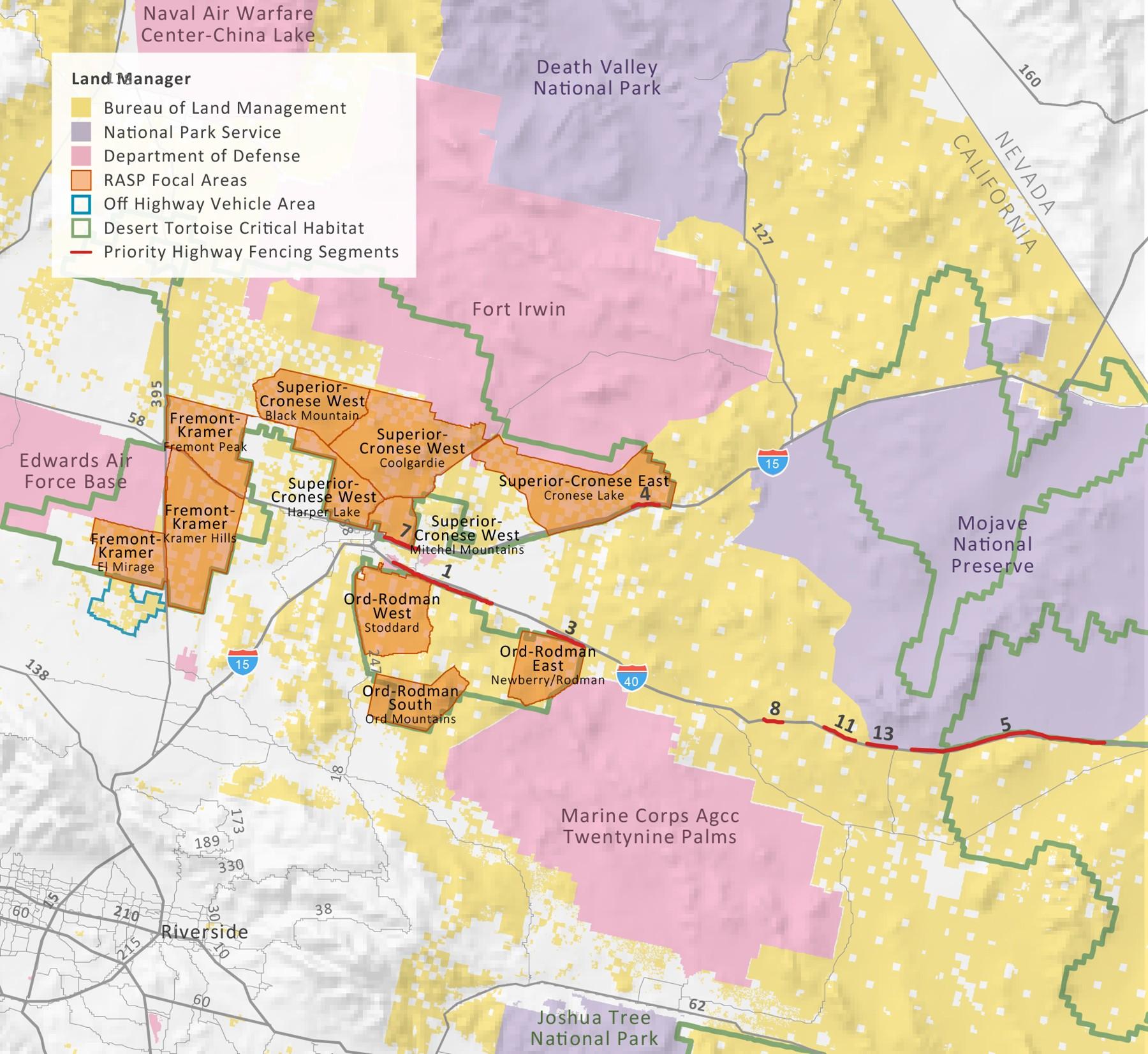
Projects that address Mojave desert tortoise conservation needs should be located in one or more of six RASP focal areas in the Western Mojave Recovery Unit, and highway exclusion fencing projects will be prioritized along priority road sections identified in Figure 2.
All applicants are required to set up a pre-application call with the RASP Coordinator (contact information at the end of this RFP) to discuss whether their proposed project fits within the geographic priorities of the RASP for the proposed activities.
The Category 2 RASP focal areas can be viewed on NFWF’s GIS web portal.
PROGRAM PRIORITIES: CATEGORY 2 RASP GRANTS
Competitive projects in each category will address at least one of the following priorities for their category. Category 2 (RASP) projects that directly implement specific strategies and goals under NFWF’s Mojave Desert Tortoise Recovery Implementation Plan will be most competitive for RASP funding. Category 2 applicants are strongly encouraged to review this document. Category 2 RASP grants supplement the existing Department of Interior (DOI) and Department of War (DoW) Mojave desert tortoise RASP Partnership; projects will be reviewed to meet agency priorities. Applicants are strongly encouraged to highlight any areas of their proposed work that overlaps with these specific strategies, geographies and goals.
Proposed projects should fit within existing land use management plans for the region, including the West Mojave Route Network Project Land Use Plan Amendment, Desert Renewable Energy Conservation Plan, and the FWS’ 2011 Revised Recovery Plan for the Mojave Population of the Desert Tortoise. The applicant should indicate the context of their proposed projects within these or other relevant plans that promote Mojave desert tortoise conservation.
Priority Category 2 recovery activities that address key limiting factors for Mojave desert tortoises in California’s West Mojave Desert are listed in order of priority below. Requests for funding for planning and compliance to enable project implementation will be considered.
Closure of unauthorized routes and habitat restoration – Install signs or physical barriers on unauthorized routes to indicate route closures. Restore habitat and mask incursion points for unauthorized routes through vertical mulching, invasive species control, native seeding and outplanting, and other restoration activities in order to establish defensible polygons of tortoise habitat. Projects should be geographically aligned with one or more of the Priority Project Areas identified in Figure 2. Route restoration projects are encouraged to include appropriate community outreach and education strategies to maintain route closures.
Improve tortoise road crossings – Install, repair, maintain or enhance tortoise exclusion fencing along highways to reduce tortoise highway mortality. Priority sections identified in Figure 2, especially adjacent to RASP focal areas, are of special interest but other highway fencing projects in the West Mojave will be considered. Install, repair or enhance culverts or other underpass structures along barrier fencing to mitigate effects of habitat fragmentation and allow for safe tortoise movement past highways.
Species monitoring – Support ongoing and new Mojave desert tortoise monitoring and analysis, particularly for population demographics, to inform progress towards medium-term population objectives and inform conservation decision making. Priority will be given to monitoring efforts that are associated with habitat protection or restoration projects and include adaptive management plans or population monitoring efforts in the Superior Cronese – West Focal Area.
Land acquisitions and conservation easements – Acquire land from willing landowners or establish conservation easements within the focal areas. Priorities would be inholdings that are strategically important for advancing restoration actions, which would connect multiple existing conservation lands within critical habitat areas, or which are particularly cost-effective (see “Evaluation Criteria” below). A funding mechanism for long-term stewardship of acquired lands or conservation easements should be included in this strategy.
PROJECT METRICS: CATEGORY 2 RASP GRANTS
To better gauge progress on individual grants and to ensure greater consistency of project data provided by multiple grant projects, the West Mojave Resilience and Desert Tortoise Recovery Partnership has a list of metrics in Easygrants for full proposal applicants to choose from for reporting (commonly used metrics are shown in the table below). We ask that you select the most relevant metrics from this list for your project. If you do not believe an applicable metric has been provided, please contact Kirstin Neff (Kirstin.Neff@nfwf.org) to discuss acceptable alternatives.
| Project Activity | Recommended Metric | Additional Guidance |
| Protect existing habitat from conversion | Habitat Conservation – Conservation easements – Acres protected under long-term easement (permanent or >30-yr) | Enter the number of acres protected under long-term easement (permanent or greater than 30 years). |
| Protect existing habitat from conversion | Habitat Conservation – Land acquisitions – Acres acquired in fee | Enter the number of acres acquired in fee for Mojave desert tortoise habitat protection. |
| Establish defensible polygons of Mojave desert tortoise (MDT) habitat | Habitat Conservation – Site protection – # of acres with enhanced protection | Enter the total number of acres protected within an estimated defensible polygon. |
| Restore or enhance MDT habitat | Habitat Restoration – Land restoration – Acres restored | Enter the number of acres actively restored for Mojave desert tortoise habitat, and describe the restoration activities in the metric notes. |
| Produce native plants for MDT habitat restoration | Habitat Restoration – Plant cultivation – # seedlings propagated | Enter the number of seedlings propagated for Mojave desert tortoise habitat restoration. In the notes, indicate the number of seedlings of each species. |
| Collect native seeds for MDT habitat restoration | Habitat Restoration – Seed harvesting – lbs harvested | Enter the number of pounds of seeds collected. |
| Improve infrastructure to reduce highway mortality of MDT | Habitat Management – BMP implementation for fencing improvements – Miles of fencing improved | Enter the number of miles of highway exclusion fencing repaired. In the notes, describe the location of the fencing segments. |
| Improve infrastructure to reduce highway mortality of MDT | Habitat Management – BMP implementation for fencing improvements – Miles of fencing installed | Enter the number of miles of new highway exclusion fencing installed. |
| Close unauthorized OHV routes to protect MDT habitat | Habitat Management – BMP implementation to mitigate recreational disturbance – # of sites with BMPs | Enter the number of sites with vertical mulching conducted and/or physical barriers installed to discourage use of unauthorized OHV routes. |
| Establish defensible polygons of MDT habitat | Habitat Management – Improved management practices – Number of sites under improved management | Enter the number of defensible restoration polygons established. In the notes, indicate the sizes of these polygons. The total area of the polygons should be reported in the metric “Habitat Conservation – Site protection - # of acres with enhanced protection.” |
| Close unauthorized OHV routes to protect MDT habitat | Capacity, Outreach, Incentives – Outreach/ Technical Assistance – # of educational signs installed | Enter the number of signs displaying permitted use installed on unauthorized OHV routes. |
| Engage public land users regarding MDT conservation needs | Capacity, Outreach, Incentives – Outreach/ Technical Assistance – # people reached | Enter the number of people who responded positively to outreach, training, or technical assistance activities, for example by signing up for an event, distribution list, or meeting with a conservation professional. This should be a subset of # people targeted to engage in conservation actions. |
| Engage public land users regarding MDT conservation needs | Capacity, Outreach, Incentives – Outreach/ Technical Assistance – # people targeted | Enter the number of people targeted to participate in a conservation action via social media, email, newsletters, in-person activities or other outreach, training, or technical assistance activities. |
| Improve infrastructure to reduce highway mortality of MDT | Species-specific Strategies – Improving migration corridors - # of road crossing improvements | Enter the number of highway underpasses such as culverts installed or improved. |
| Expand species monitoring to new and additional sites | Planning, Research, Monitoring – Monitoring – # sites being monitored | Enter the number of new population monitoring sites for Mojave desert tortoise. Describe the type of population monitoring being conducted in the metric notes. |
| Comply with state and federal data collection and management standards | Planning, Research, Monitoring – Monitoring – # of studies whose findings are reported to management | Enter the number of datasets or monitoring reports produced and entered into relevant databases. Describe each reported dataset and/or study in the metric notes. |
ELIGIBILITY: ALL GRANT CATEGORIES
Eligible and Ineligible Entities
- Eligible applicants include: local, state, federal, and Tribal governments and agencies (e.g., counties, cities, towns), special districts (e.g., conservation districts, planning districts, utility districts), non-profit 501(c) organizations, educational institutions, and commercial (for-profit) organizations.
- For-profit applicants: please note that this is a request for grant proposals, not a procurement of goods and services; see the Budget section below for specific cost considerations.
- Ineligible applicants include: international organizations or unincorporated individuals.
MATCH REQUIREMENT: ALL GRANT CATEGORIES
Match is encouraged but not required. Eligible matching sources can include cash, in-kind donations, and/or volunteer labor which are directly related to the project proposed for funding. Applicants must distinguish between federal and non-federal matching fund sources.
Due to the funding sources involved in this partnership, leverage and match are encouraged but not required. Leverage and match will be evaluated for its demonstration of project partnerships, not for the dollar amount contributed, and can include cash, in-kind or volunteer contributions. Leverage should be reported in the proposal narrative in Easygrants. Matching contributions should be included in the “Matching Contributions” section of the proposal task in Easygrants. Please contact NFWF staff and review the Applicant Tip Sheet for additional guidance on how to report leverage and match in the proposal.
Leverage:
- Leverage does not need to follow the rules outlined below for matching contributions. Leverage is intended to demonstrate community support and project partnerships rather than commit a specific amount of funding to the project.
- Leverage does not need to be quantified with a dollar value if that is not applicable to the partnerships you wish to convey.
- Leverage could include costs or other funding related to previous or current phases of the project, including design, on-the-ground implementation, or ongoing management actions. This section can also capture grant awards that have already been used to match other funding sources but still contribute to the overall outcomes of the project.
Match:
Non-federal Matching Contributions:
- Verifiable from the grantee’s records
- Not included as contributions for any other Federal award
- Reasonable and necessary for accomplishment of project or program objectives
- Committed directly to the project and used within the period of performance
- Allowable under OMB 2 CFR 200 Cost Principles
Federal Matching Contributions:
- Verifiable from the grantee’s records
- Reasonable and necessary for accomplishment of project or program objectives
- Committed directly to the project and used within the period of performance
- Special conditions may apply under the Mojave Desert Sentinel Landscape
EVALUATION CRITERIA : ALL GRANT CATEGORIES
All proposals will be screened for relevance, accuracy, completeness and compliance with NFWF and funding source policies. Proposals will then be evaluated based on the extent to which they meet the following criteria.
| Conservation Outcomes | Budget | Technical |
|
|
|
Partnership and Community Impact – The applicant organization partners and engages collaboratively with relevant stakeholders to develop and implement the proposed project. This ensures long-term sustainability and success of the project, integration into local programs and policies, and community acceptance of proposed restoration actions. Partners or communities are enlisted to broaden the sustained impact from the project. Describe the community characteristics of the project area, identify any communities impacted, describe outreach and community engagement activities and how those will be monitored and measured. Use data to support descriptions and submit letters of support from community partners and/or collaborators demonstrating their commitment to the project and engagement in project activities as proposed.
Budget – Costs are allowable, reasonable and budgeted in accordance with NFWF’s Budget Instructions cost categories. Federally-funded projects must be in compliance with OMB Uniform Guidance as applicable.
Matching Contributions – Matching Contributions consist of cash, contributed goods and services, volunteer hours, and/or property raised, spent, and acquired for the Project during the Period of Performance. Larger match ratios and matching fund contributions from a range of partners are encouraged and will be more competitive during application review.
Proposal Cost-Effectiveness – Cost-effectiveness analysis identifies the economically most efficient way to meet project objectives. Project includes a cost-effective budget that balances performance risk and efficient use of funds. Cost-effectiveness evaluation includes, but is not limited to, an assessment of effective direct/indirect costs across all categories in the proposed budget according to the type, size and duration of the project and project objectives. Project budgets will be compared to similar projects to ensure proposed costs across all budget categories are reasonable for the activities being performed and the outcomes proposed.
Spatial Data – Project spatial data submitted to NFWF’s online mapping tool accurately represent the location(s) of conservation activity(ies) at the time of proposal submission. Successful projects will be required to submit improved spatial data for each conservation activity within the period of performance as necessary.
OTHER: ALL GRANT CATEGORIES
Ineligible Uses of Grant Funds
- NFWF funds and matching contributions are strictly prohibited from being used for a number of reasons to include, for example, political advocacy, fundraising, lobbying, litigation, terrorist activities, or in violation of the Foreign Corrupt Practices Act. See OMB Uniform Guidance for additional information.
- Equipment: Applicants are encouraged to rent equipment where possible and cost-effective, or use matching funds to make those purchases. NFWF acknowledges, however, that some projects may only be completed using NFWF funds to procure equipment. If this applies to your project, please contact the program staff listed in this RFP to discuss options.
- Federal funds and matching contributions may not be used to procure or obtain equipment, services, or systems (including entering into or renewing a contract) that use telecommunications equipment or services produced by Huawei Technologies Company or ZTE Corporation (or any subsidiary or affiliate of such entities) as a substantial or essential component, or as critical technology of any system. Refer to Public Law 115-232, section 889 for additional information.
- Pursuant to the American Security Drone Act (ASDA), effective December 22, 2025, applicants proposing activities funded in whole or in part with federal funds may not use, operate, or purchase any drone or uncrewed aerial systems (UAS) included on the Covered Foreign Entities (CFE) List. This prohibition applies to both new purchases and continued use of existing UAS, including certain widely used commercial platforms, such as DJI and Autel. Applicants are responsible for ensuring that all proposed and existing UAS used in connection with federally funded activities comply with applicable federal law and are not included on the CFE List. Noncompliance may affect eligibility for funding.
- NFWF funds may not be used to support ongoing efforts to comply with legal requirements, including permit conditions, mitigation and settlement agreements. However, grant funds may be used to support projects that enhance or improve upon existing baseline compliance efforts.
Environmental Services – NFWF funds projects in pursuit of its mission to sustain, restore and enhance the nation's fish, wildlife, plants and habitats for current and future generations. NFWF recognizes that some benefits from projects may be of value with regards to credits on an environmental services market (such as a carbon credit market). NFWF does not participate in, facilitate, or manage an environmental services market nor does NFWF assert any claim on such credits.
Intellectual Property – Intellectual property created using NFWF awards may be copyrighted or otherwise legally protected by award recipients. NFWF may reserve the right to use, publish, and copy materials created under awards, including posting such material on NFWF’s website and featuring it in publications. NFWF may use project metrics and spatial data from awards to estimate societal benefits that result and to report these results to funding partners. These may include but are not limited to: habitat and species response, species connectivity, water quality, water quantity, and risk of detrimental events (e.g., wildfire, floods).
Procurement – If the applicant chooses to specifically identify proposed Contractor(s) for Services, an award by NFWF to the applicant does not constitute NFWF’s express written authorization for the applicant to procure such specific services noncompetitively. When procuring goods and services, NFWF award recipients must follow documented procurement procedures which reflect applicable laws and regulations.
Publicity and Acknowledgment of Support – Award recipients will be required to grant NFWF the right and authority to publicize the project and NFWF’s financial support for the grant in press releases, publications and other public communications. Recipients may also be asked by NFWF to provide high-resolution (minimum 300 dpi) photographs depicting the project.
Receiving Award Funds – Award payments are primarily reimbursable. Projects may request funds for reimbursement at any time after completing a signed agreement with NFWF. A request of an advance of funds must be due to an imminent need of expenditure and must detail how the funds will be used and provide justification and a timeline for expected disbursement of these funds. Requests for monthly advances will not be considered.
Compliance Requirements – Projects selected may be subject to requirements under the National Environmental Policy Act, the Endangered Species Act (state and federal), and the National Historic Preservation Act. Documentation of compliance with these regulations must be approved prior to initiating activities that disturb or alter habitat or other features of the project site(s). Applicants should budget sufficient time and resources to obtain the needed approvals. As may be applicable, successful applicants may be required to comply with additional Federal, state or local requirements and obtain all necessary permits and clearances.
HOW TO APPLY
All application materials must be submitted online through National Fish and Wildlife
Foundation’s Easygrants system.
- Go to easygrants.nfwf.org to register in our Easygrants online system. New users to the system will be prompted to register before starting the application (if you already are a registered user, use your existing login). Enter your applicant information. Please disable the pop-up blocker on your internet browser prior to beginning the application process.
- Once on your homepage, click the “Apply for Funding” button and select this RFP’s “Funding Opportunity” from the list of options.
- Follow the instructions in Easygrants to complete your application. Once an application has been started, it may be saved and returned to at a later time for completion and submission.
APPLICATION ASSISTANCE
A Tip Sheet is available for quick reference while you are working through your application.
Additional information to support the application process can be accessed on the NFWF website’s Applicant Information page.
For more information or questions about this RFP, please contact:
For general program questions:
Kirstin Neff
Program Director, Southwest
Kirstin.Neff@nfwf.org
(303) 222-6485
Emma Wigger
Manager, Regional Programs
Emma.Wigger@nfwf.org
(202) 888-1680
For application questions and to schedule a pre-application meeting:
Trevor Davis
Coordinator, Regional Programs
Trevor.Davis@nfwf.org
(202) 595-2442
To discuss project ideas and geographic priority areas for Category 1 Landscape Resilience grants:
Jesse Ross
Coordinator, Innovation Landscapes of the Southwest
USMC Resilience Technical Support
Jesse.j.ross15.civ@us.navy.mil
(805) 663-3092
To discuss project ideas and geographic priority areas for Category 2 RASP grants:
Kristina Drake
Director of Conservation Ecology & RASP Coordinator
Mojave Desert Land Trust
kristina.drake@mdlt.org
(702) 682-5596
Clay Noss
Co-RASP Coordinator
Mojave Desert Land Trust
Clay.Noss@mdlt.org
(760) 366-5440 ext. 261
For issues or assistance with our online Easygrants system, please contact:
Easygrants Helpdesk
Email: Easygrants@nfwf.org
Voicemail: 202-595-2497
Hours: 9:00 am to 5:00 pm ET, Monday-Friday.
Include: your name, proposal ID #, e-mail address, phone number, program you are applying to, and a description of the issue.