Alaska Fish and Wildlife Fund 2027 Request for Proposals
RFP GUIDANCE
NFWF is committed to operating in full compliance with all applicable laws, regulations, and Executive Orders. We continuously monitor legal and regulatory developments to ensure our policies, procedures, and operations align with current federal directives. We encourage all applicants to do the same.
The ability and extent to which NFWF is able to make awards is contingent upon receipt of funds from federal agencies and/or other funding partners. Final funding decisions will be made based on the applications received and the level and timing of funding received by NFWF.
TIMELINE
Dates of activities are subject to change. Please check the program page of the NFWF website for the most current dates and information: Alaska Fish and Wildlife Fund
Applicant Webinar - Tuesday, September 15, 2026 at 12:00 PM Alaska Time
Full Proposal Due Date - Wednesday, October 28, 2026 by 7:59 PM Alaska Time
Review Period - October 2026 – March 2027
Awards Announced - March 2027
OVERVIEW
The National Fish and Wildlife Foundation (NFWF) is soliciting proposals to further conservation of species and habitats in Alaska. The Alaska Fish and Wildlife Fund (AFWF) invests in projects that achieve or substantially lead to measurable on-the-ground conservation outcomes and fill key information gaps through assessments and strategic monitoring that result in improved habitat or population management actions. The availability of federal funds estimated in this solicitation is contingent upon the federal appropriations process. Funding decisions will be made based on level of funding and timing of when it is received by NFWF.
Support for the AFWF is provided by the U.S. Fish and Wildlife Service (USFWS) and U.S. Forest Service (USFS). Grants may be awarded using one or more of these sources of funding.
GRANT AWARD INFORMATION
Grant awards generally range in size from $50,000 to $200,000, although grants greater than $200,000 will be considered on a case-by-case basis. Projects may extend from one to two years. Projects must have a minimum match of 1:1 non-federal cash or in-kind contributions. While federal contributions cannot be used as match, all potential sources of contributions, including federal, should be listed in the application for consideration during the review process.
GEOGRAPHIC FOCUS
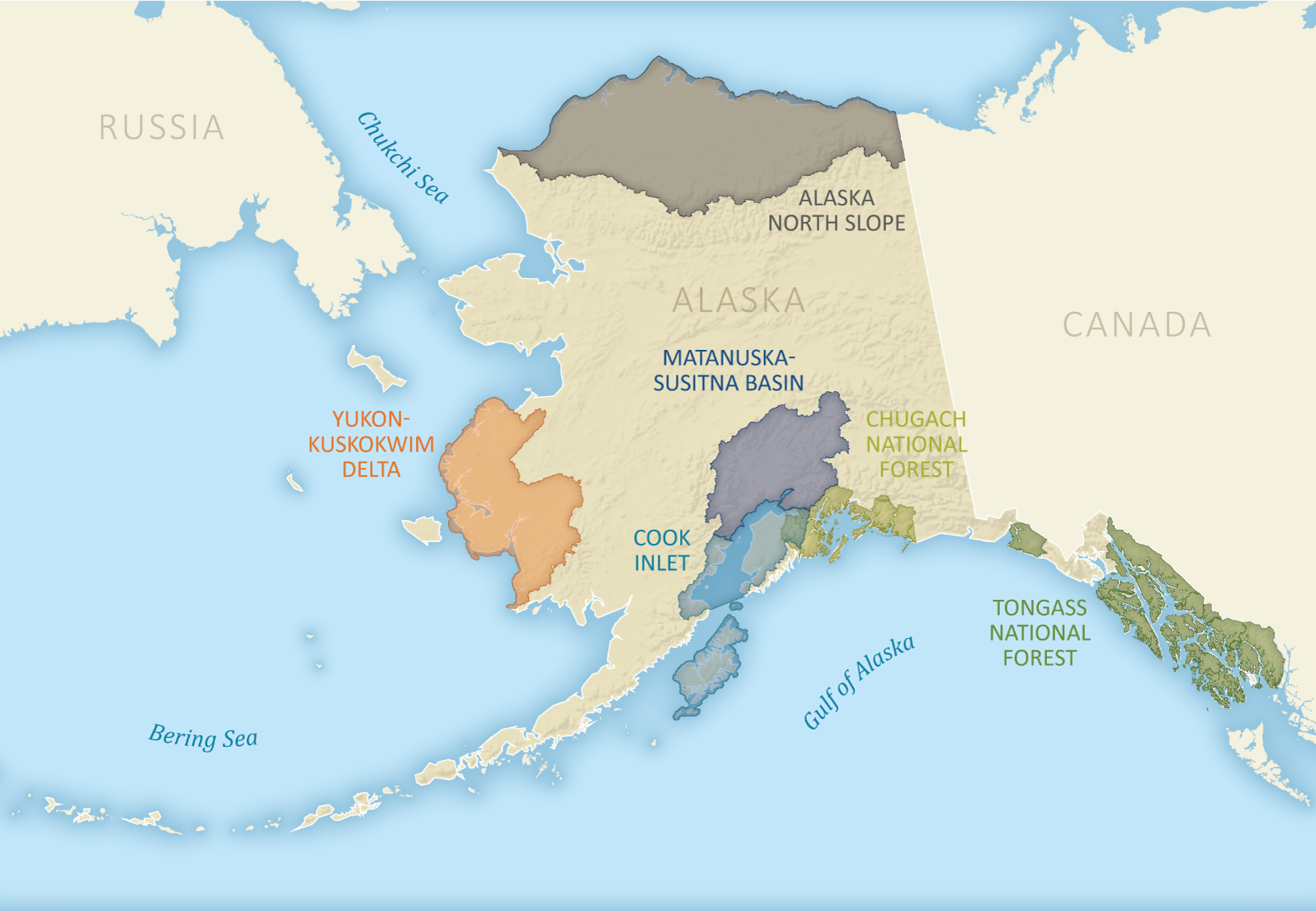
Grants will be awarded to projects that occur within the geographies highlighted in Map 1, and as listed below:
- Alaska North Slope
- Yukon-Kuskokwim Delta
- Cook Inlet/Matanuska-Susitna Basin/Kodiak Archipelago
- Chugach and Tongass National Forests
PROGRAM PRIORITIES
All proposals must specifically address how projects will directly and measurably contribute to at least one of the following priorities. Where applicable, emphasis will be placed on projects that support watershed or headwaters-based approaches that complement existing programs. To adequately describe outcomes, include Project Metrics (options listed below). Projects that incorporate outreach to Alaska Native communities, foster community engagement, and pursue collaborative management while elevating indigenous knowledge that will lead to measurable conservation benefits are encouraged.
Alaska North Slope
The primary efforts of the AFWF in the Alaska North Slope are filling key knowledge gaps and mitigating direct threats to species populations. In 2027, the AFWF seeks projects in the following priority areas in the Alaska North Slope:
- Fill key information gaps for fish and wildlife populations that will result in improved monitoring and management of species impacted by development and changing climate conditions.
- Fill key information gaps on migratory movements of birds to determine areas within and outside of the Arctic where they may be vulnerable.
- Implementation of monitoring to assess migratory bird populations, abundance, and trends.
- Implementation of PRISM (Program for Regional and International Shorebird Monitoring) surveys to provide comprehensive, reliable, and timely information on the status and trends of shorebird populations along the Alaska North Slope.
- Implement conservation actions identified in the Pacific Birds Habitat Joint Venture’s North Pacific Flyway Coastal Wetlands Strategic Plan (2024-2034), with a particular emphasis on projects that benefit Tier 1 and Tier 2 priority coastal wetland bird species.
Yukon-Kuskokwim Delta
The AFWF supports Pacific salmon projects in collaboration with Alaska Fish Habitat Partnerships, and/or other watershed-based partnerships throughout the Yukon-Kuskokwim Delta. High priority projects will fill information gaps to inform conservation actions and improve Pacific salmon subsistence management, as well as protect, enhance, and restore fish habitat to ensure long-term viability of the stock complex. In 2027, the AFWF seeks projects in the following priority areas:
- Partnering with Tribes, Indigenous leaders, agencies, and community partners to co-steward wild Pacific salmon and their habitats in support of the U.S. Department of the Interior’s Gravel to Gravel Keystone Initiative within Alaska.
- Facilitate detection of population-level changes in stock characteristics (e.g., age, sex, length, and genetic composition).
- Strengthen monitoring, refine escapement models, and enhance practices for the management and conservation of Pacific salmon. A topic of interest in 2027 includes studies to better understand the quality of escapement.
- Increase understanding of the composition of returning runs to improve effectiveness of management decisions in-season, to develop run re-constructions, and develop outlooks for returns in future years.
- Enhance hydrologic and water quality information essential to identify, monitor, and conserve key Pacific salmon resources. Topics of interest in 2027 include filling information gaps on thermal landscapes of freshwater Pacific salmon habitat and studies that investigate water temperature impact on Pacific salmon productivity or the potential redistribution of Pacific salmon in a changing climate.
- Maintain and improve connectivity and access to existing habitat including the removal of barriers (e.g., culverts).
- Habitat restoration planning, design, outreach, or implementation activities.
Chugach and Tongass National Forests
NFWF and its partners seek to improve ecological function in watersheds within, and adjacent to, the Chugach and Tongass National Forests. The focus will be on in-stream restoration, aquatic organism passage, and terrestrial wildlife improvements. Proposals that achieve multi-species benefit are most desirable, but should align with the following priority objectives:
- Assist USFS personnel with the collection of baseline data, planning, and design for culvert removal or replacement to improve hydrologic connectivity and aquatic organism passage. Projects that utilize Alaska Native interns are a priority.
- Conduct comprehensive watershed assessment and watershed restoration action plan activities.
- Implement instream habitat restoration and fish passage improvement projects.
- Conduct terrestrial habitat restoration that benefits wildlife and subsistence resources. Restoration activities should be self-sustaining and/or utilize a holistic approach to restoration that has multiple benefits to fish and wildlife.
- Support work that assists land managers with critical data and analysis needs for effective management of fish and wildlife habitat and species conservation.
Cook Inlet, Matanuska-Susitna Basin, and Kodiak Archipelago
The AFWF strives to support comprehensive watershed management approaches to conserving fish and wildlife in the Cook Inlet, Matanuska-Susitna Basin, and Kodiak Archipelago regions. In 2027, the AFWF seeks projects in the following priority areas:
- Restore, enhance, and conserve Pacific salmon habitat that complements or advances the goals of relevant Alaska-based Fish Habitat Partnerships in the Cook Inlet, Matanuska-Susitna Basin, and Kodiak Archipelago regions.
- Facilitate acquisition of improved hydrologic and other biological information essential to identify, monitor, and conserve key Pacific salmon resources, including projects that result in updates to the High-Resolution National Hydrography Dataset Plus (NHDPlus HR), National Wetlands Inventory (NWI), and increase miles in the Anadromous Waters Catalog (AWC).
- Implement conservation actions identified in the Pacific Birds Habitat Joint Venture’s North Pacific Flyway Coastal Wetlands Strategic Plan (2024-2034), with a particular emphasis on projects that benefit Tier 1 and Tier 2 priority coastal wetland bird species.
PROJECT METRICS
To better gauge progress on individual grants and to ensure greater consistency of project data provided by multiple grants, the AFWF has a list of metrics in Easygrants for full proposal applicants to choose from for future reporting. We ask that applicants select only the most relevant metrics from this list for their project (all possible program metrics are shown in the table below). If you think an applicable metric has not been provided, please contact Jana Doi (jana.doi@nfwf.org) to discuss acceptable alternatives.
| Project Activity | Recommended Metric | Additional Guidance |
| Fish Passage Improvements | # of barriers assessed and/or with design plans | Enter the # of in-stream barriers with assessments or engineering and design plans completed through this grant. A barrier is any artificial in-stream structure (e.g., culverts, dams, dikes, fords, pipes, weirs) that may obstruct aquatic organism passage. In the notes, provide the barrier's SARP ID (aquaticbarriers.org). If the barrier(s) is not in SARP, provide its lat/long or its name and source. |
| Fish Passage Improvements | # passage barriers rectified | Enter the # of in-stream barriers removed or rectified as part of THIS grant to improve aquatic organism passage and/or flooding. If multiple barriers exist at one specific location, please list "1" and list each individual barrier in the notes. In the notes, provide the barrier's SARP ID--see SARP Natl. Aq. Barrier Inventory (aquaticbarriers.org). If the barrier(s) is not in SARP, provide its lat/long or its name and source. |
| Fish Passage Improvements | # miles of stream opened | Enter total # of miles opened to improve aquatic organism passage. Only include the miles of main stem & smaller tributaries connected until the next barrier upstream (or headwaters), but NOT lakes, ponds, or distance downstream from the barrier removed. |
| Instream Restoration | # miles of instream habitat restored | Enter the number of miles of instream habitat restored. In the metric notes section, describe the location(s) where the instream restoration took place. |
| Land Restoration | Acres Restored | Enter # acres of habitat restored. In the NOTES, specify landcover prior to restoration (barren, cropland, grass, shrub) and post-restoration (broadleaf, conifer, redwood, grassland, shrubland, marsh, wet meadow, tidal marsh, swamp, seagrass, kelp forest) |
| Research | # acres of watersheds assessed | Enter the number of acres of watersheds assessed to inform future habitat restoration activities. In the metric notes section, describe the location(s) where the watershed assessment(s) took place. |
| Research | # studies reported to management | Enter the number of studies completed whose findings are reported to management. In the metric notes section, describe the types of plans or studies that were completed and which management entity it was reported to. |
| Tool Development for Decision-making | # tools developed | Enter the number of tools developed. In the metric notes section, describe the tools created. |
| Monitoring | # monitoring programs | Enter the number of monitoring programs established or underway. In the metric notes section, describe the monitoring programs. |
| Monitoring | # sites being monitored | Enter the # sites being monitored. In the metric notes section, list the sites being monitored. |
| Building Institutional Capacity | # full time employees with sufficient training | Enter the number of staff or full-time equivalents with sufficient training and skills engaged in conservation activities. In the metric notes section, describe the training completed. |
| Outreach/ Education/ Technical Assistance | # internships or fellowships | Enter the number of people employed as interns or fellows. This metric is not intended to capture new full-time employees. If any positions filled are for full time employees, please use the “# of jobs sustained” metric instead. |
| Outreach/ Education/ Technical Assistance | # people reached | Enter the number of people reached by outreach, training, or technical assistance activities. In the metric notes section, describe the type(s) of outreach and how the outreach contributes to conservation activities. Metric notes should include information as to how people were reached (i.e. community meetings, workshops, volunteer events, etc). |
| Economic Benefits | # jobs created | Enter the # of individuals hired to directly work on the project (non-volunteers). Jobs should be directly engaged in grant activities, funded by the grant, and shouldn't have existed prior to the grant. In the notes, provide the FTE for the jobs created. |
| Economic Benefits | # jobs sustained | Enter the # of paid jobs that are partially or fully sustained through this grant. Jobs should have existed prior to the grant, be funded by the grant, and be directly engaged in project activities. The starting value for this metric should be zero. |
ELIGIBILITY
Eligible and Ineligible Entities
- Eligible applicants include non-profit 501(c) organizations, U.S. Federal government agencies, state government agencies, local governments, municipal governments, tribal governments, Alaska Native tribal organizations/corporations, and educational institutions.
- Ineligible applicants include businesses, unincorporated individuals, and international organizations.
Ineligible Uses of Grant Funds
- NFWF funds and matching contributions are strictly prohibited from being used for a number of reasons to include, for example, political advocacy, fundraising, lobbying, litigation, terrorist activities, or in violation of the Foreign Corrupt Practices Act. See OMB Uniform Guidance for additional information.
- Equipment: Applicants are encouraged to rent equipment where possible and cost-effective or use matching funds to make those purchases. NFWF acknowledges, however, that some projects may only be completed using NFWF funds to procure equipment. If this applies to your project, please contact the program staff listed in this RFP to discuss options.
- Federal funds and matching contributions may not be used to procure or obtain equipment, services, or systems (including entering into or renewing a contract) that uses telecommunications equipment or services produced by Huawei Technologies Company or ZTE Corporation (or any subsidiary or affiliate of such entities) as a substantial or essential component, or as critical technology of any system. Refer to Public Law 115-232, section 889 for additional information. NFWF funds and matching contributions may not be used to support political advocacy, fundraising, lobbying, litigation, terrorist activities or Foreign Corrupt Practices Act violations.
- NFWF funds may not be used to support ongoing efforts to comply with legal requirements, including permit conditions, mitigation and settlement agreements. However, grant funds may be used to support projects that enhance or improve upon existing baseline compliance efforts.
- NFWF funds may not be used to cover permanent federal employee salary expenses.
- Pursuant to the American Security Drone Act (ASDA), effective December 22, 2025, applicants proposing activities funded in whole or in part with federal funds may not use, operate, or purchase any drone or uncrewed aerial systems (UAS) included on the Covered Foreign Entities (CFE) List. This prohibition applies to both new purchases and continued use of existing UAS, including certain widely used commercial platforms, such as DJI and Autel. Applicants are responsible for ensuring that all proposed and existing UAS used in connection with federally funded activities comply with applicable federal law and are not included on the CFE List. Noncompliance may affect eligibility for funding.
EVALUATION CRITERIA
All proposals will be screened for relevance, accuracy, completeness and compliance with NFWF and funding source policies. Proposals will then be evaluated based on the extent to which they meet the following criteria.
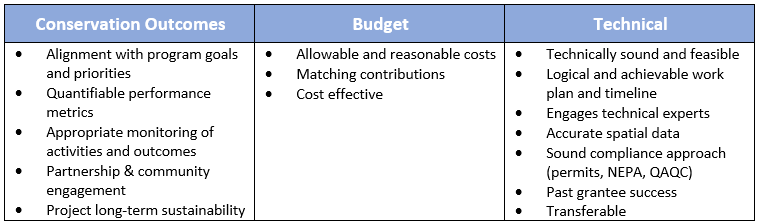
Program Goals and Priorities – Project contributes to the Program’s overall habitat and species conservation goals, and has specific, quantifiable performance metrics to evaluate project success. Project addresses one or more of the program priorities.
Technical Merit – Project is technically sound and feasible, and the proposal sets forth a clear, logical and achievable work plan and timeline. Project engages appropriate technical experts throughout project planning, design and implementation to ensure activities are technically-sound and feasible.
Spatial Data – Project spatial data submitted to NFWF’s online mapping tool accurately represent the location(s) of each conservation activity at time of proposal submission. Successful projects will be required to submit improved spatial data within the period of performance as necessary.
Partnership and Community Impact – The applicant organization partners and engages collaboratively with diverse local community members, leaders, community-based organizations, and other relevant stakeholders to develop and implement the proposed project. This ensures long-term sustainability and success of the project, integration into local programs and policies, and community acceptance of proposed restoration actions. Non-traditional partners or communities are enlisted to broaden the sustained impact from the project. Describe the community characteristics of the project area, identify any communities impacted, describe outreach and community engagement activities and how those will be monitored and measured. Use demographic data to support descriptions and submit letters of support from community partners and/or collaborators demonstrating their commitment to the project and engagement in project activities as proposed.
Cost-Effectiveness – Cost-effectiveness analysis identifies the economically most efficient way to meet project objectives. Project includes a cost-effective budget that balances performance risk and efficient use of funds. Cost-effectiveness evaluation includes, but is not limited to, an assessment of effective direct/indirect costs across all categories in the proposed budget according to the type, size and duration of project and project objectives. Project budgets will be compared to similar projects to ensure proposed costs across all budget categories are reasonable for the activities being performed and the outcomes proposed.
Transferability – Project has potential and plan to transfer lessons learned to other communities and/or to be integrated into government programs and policies.
Communication – Project includes a detailed plan to communicate information about the project to appropriate audiences.
Funding Need – Project establishes a clear need for the funds being requested, and demonstrates that activities would not move forward absent funding.
Conservation Plan and Context – The project advances an existing conservation plan or strategy.
Monitoring – Project includes a plan for monitoring progress during and after the proposed project period to track project success and adaptively address new challenges and opportunities as they arise.
Long-term Sustainability – Project will be maintained to ensure benefits are achieved and sustained over time. This should include how future funding will be secured to implement necessary long-term monitoring and maintenance activities.
Past Success – Applicant has a proven track record of success in implementing conservation practices with specific, measurable results. Project types with demonstrated ecological success are preferred.
Partnership – An appropriate partnership exists to implement the project and the project is supported by a strong local partnership that leverages additional funds and will sustain it after the life of the grant. If the organization does not have the capacity or history of successes needed to constitute a competitive application alone, we highly encourage organizations to identify and collaborate with partner organizations to increase capacity and improve project design and outcomes. These partnerships may include multiple organizations needed to implement the project and authentically engage local stakeholders but elevate one higher capacity organization to act as the applicant and pass-through entity for project funding if needed. Identify proposed partners, if known (including potential or contemplated subawards to third party subrecipients of the applicant), the roles they will play in implementing the project, and how this project will build new or enhance existing partnerships. (Note: a project partner is any local community, non-profit organization, tribe, and/or local, state, and federal government agency that contributes to the project in a substantial way and is closely involved in the completion of the project.)
OTHER
Budget – Costs are allowable, reasonable and budgeted in accordance with NFWF’s Budget Instructions cost categories. Federally-funded projects must be in compliance with OMB Uniform Guidance as applicable.
Environmental Services – NFWF funds projects in pursuit of its mission to sustain, restore and enhance the nation's fish, wildlife, plants and habitats for current and future generations. NFWF recognizes that some benefits from projects may be of value with regards to credits on an environmental services market (such as a carbon credit market). NFWF does not participate in, facilitate, or manage an environmental services market nor does NFWF assert any claim on such credits.
Intellectual Property – Intellectual property created using NFWF awards may be copyrighted or otherwise legally protected by award recipients. NFWF may reserve the right to use, publish, and copy materials created under awards, including posting such material on NFWF’s website and featuring it in publications. NFWF may use project metrics and spatial data from awards to estimate societal benefits that result and to report these results to funding partners. These may include but are not limited to: habitat and species response, species connectivity, water quality, water quantity, risk of detrimental events (e.g., wildfire, floods), carbon accounting (e.g., sequestration, avoided emissions).
Matching Contributions – Matching Contributions consist of cash, contributed goods and services, volunteer hours, and/or property raised and spent for the Project during the Period of Performance. Larger match ratios and matching fund contributions from a range of partners are encouraged and will be more competitive during application review.
Procurement – If the applicant chooses to specifically identify proposed Contractor(s) for Services, an award by NFWF to the applicant does not constitute NFWF’s express written authorization for the applicant to procure such specific services noncompetitively. When procuring goods and services, NFWF recipients must follow documented procurement procedures which reflect applicable laws and regulations.
Publicity and Acknowledgement of Support – Award recipients will be required to grant NFWF the right and authority to publicize the project and NFWF’s financial support for the grant in press releases, publications and other public communications. Recipients may also be asked by NFWF to provide high-resolution (minimum 300 dpi) photographs depicting the project.
Receiving Award Funds – Award payments are primarily reimbursable. Projects may request funds for reimbursement at any time after completing a signed agreement with NFWF. A request of an advance of funds must be due to an imminent need of expenditure and must detail how the funds will be used and provide justification and a timeline for expected disbursement of these funds.
Compliance Requirements – Projects selected may be subject to requirements under the National Environmental Policy Act, Endangered Species Act (state and federal), and National Historic Preservation Act. Documentation of compliance with these regulations must be approved prior to initiating activities that disturb or alter habitat or other features of the project site(s). Applicants should budget time and resources to obtain the needed approvals. As may be applicable, successful applicants may be required to comply with additional Federal, state or local requirements and obtain all necessary permits and clearances.
Quality Assurance – If a project involves significant monitoring, data collection or data use, grantees will be asked to prepare and submit quality assurance documentation (www.epa.gov/quality). Applicants should budget time and resources to complete this task.
Permits – Successful applicants will be required to provide sufficient documentation that the project expects to receive or has received all necessary permits and clearances to comply with any Federal, state or local requirements. Where projects involve work in the waters of the United States, NFWF strongly encourages applicants to conduct a permit pre-application meeting with the Army Corps of Engineers prior to submitting their proposal. In some cases, if a permit pre-application meeting has not been completed, NFWF may require successful applicants to complete such a meeting prior to grant award.
Federal Funding – The availability of federal funds estimated in this solicitation is contingent upon the federal appropriations process. Funding decisions will be made based on level of funding and timing of when it is received by NFWF.
HOW TO APPLY
All application materials must be submitted online through National Fish and Wildlife Foundation’s Easygrants system.
- Go to easygrants.nfwf.org to register in our Easygrants online system. New users to the system will be prompted to register before starting the application (if you already are a registered user, use your existing login). Enter your applicant information. Please disable the pop-up blocker on your internet browser prior to beginning the application process.
- Once on your homepage, click the “Apply for Funding” button and select this RFP’s “Funding Opportunity” from the list of options.
- Follow the instructions in Easygrants to complete your application. Once an application has been started, it may be saved and returned to at a later time for completion and submission.
APPLICATION ASSISTANCE
A Tip Sheet is available for quick reference while you are working through your application.
Additional information to support the application process can be accessed on the NFWF website’s Applicant Information page.
For more information or questions about this RFP, please contact:
Jana Doi
Director, Alaska and Pacific Islands Programs
jana.doi@nfwf.org
(415) 243-3102
For issues or assistance with our online Easygrants system, please contact:
Easygrants Helpdesk
Email: Easygrants@nfwf.org
Voicemail: 202-595-2497
Hours: 9:00 am to 5:00 pm ET, Monday-Friday.
Include: your name, proposal ID #, e-mail address, phone number, program you are applying to, and a description of the issue.