Great Plains Grassland Fund 2026 - 2027 Request for Proposals
RFP GUIDANCE
NFWF is committed to operating in full compliance with all applicable laws, regulations, and Executive Orders. We continuously monitor legal and regulatory developments to ensure our policies, procedures, and operations align with current federal directives. We encourage all applicants to do the same.
The ability and extent to which NFWF is able to make awards is contingent upon receipt of funds from federal agencies and/or other funding partners. Final funding decisions will be made based on the applications received and the level and timing of funding received by NFWF.
TIMELINE
Dates of activities are subject to change. Please check the program page of the NFWF website for the most current dates and information [Great Plains Grassland Fund]. NFWF strongly encourages applicants to meet with NFWF staff to discuss project ideas prior to the application deadline.
Applicant Webinar [Watch here]: October 23, 2026 1:00 p.m. MT
Full Proposal Due Date: January 27, 2027, 9:59 p.m. MT
Awards Announced: May 2027
OVERVIEW
The Great Plains Grassland Fund (GPGF) seeks proposals to help permanently protect intact grasslands that are the centerpiece of rural economies in the United States. This funding opportunity will build on community-based, voluntary rancher-led efforts and invest in land protection and management strategies to reduce the risk of grassland conversion in high-value landscapes. The fundamental conservation strategy used in this program will be voluntary conservation easements, but applicants are encouraged to supplement easements with the use of other tools such as grassbanks, grazing associations, or other community-led models that help mitigate the pressure to convert grasslands in the surrounding area.
The primary purpose of this funding opportunity is to protect grasslands that are at high risk of conversion to cropland or intensive developed uses and leverage those protected grasslands to help strengthen the management and resilience of surrounding working lands. Projects will build upon locally led, rancher-driven efforts and promote durable, flexible, and integrated land protection and management strategies designed to reduce the likelihood of grassland conversion. Funders for this program will not make claims on carbon or purchase carbon credits that could be generated from the avoided conversion of the grasslands.
Applicants should include all potential conservation easement properties into one application rather than submitting multiple applications. In some cases, when a proposal requests funding for multiple properties, NFWF may offer partial funding for a specific subset of properties. We also encourage applications proposing a model or concept for deployment without specific properties identified in advance. Partnerships between multiple organizations are encouraged, especially those that engage organizations funded under the Grassland Resilience and Conservation Initiative, as targeting land protection alongside existing grassland restoration work can help create synergies and connectivity between programs.
GRANT AWARD INFORMATION
Up to $10 million will be available to support projects in 2027. All grant awards require a minimum 1:1 match of cash or contributed goods and services. Both federal and non-federal funds may be considered as match. Match from partners engaging in supplemental land restoration work coordinated alongside land protection may also be considered as match. Please include ALL matching sources no matter the status (intend to apply, application submitted, pledged, received). Other NFWF programs involving land conservation typically receive proposals with matching funds at a 5:1 ratio or greater.
GEOGRAPHIC FOCUS
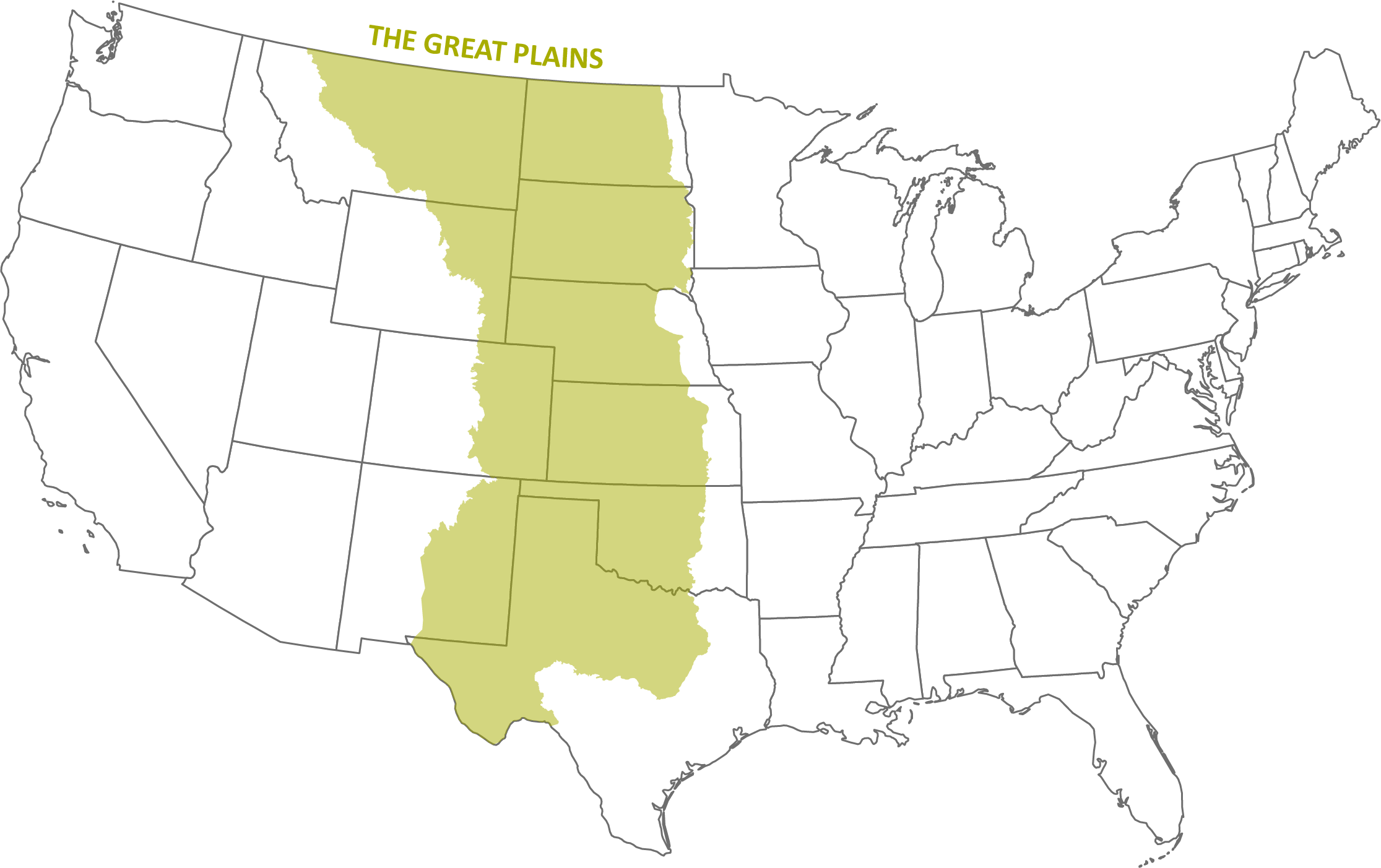
This funding opportunity will support land conservation efforts on grass-dominated landscapes across the Great Plains. See the figure below for the program boundary for the Great Plains Grassland Fund.
PROGRAM PRIORITIES
Preferential consideration will be given to proposals that can demonstrate their ability to achieve more than one of the program priorities below.
- Protect areas at high risk of conversion to cropland or other development, as demonstrated through land suitability assessment and analysis of local conversion rates. Reviewers may use tools such as Climate Action Reserve’s GrassTool for evaluation of conversion risk.
- Preserve intact grasslands and/or restore convertible lands to grassland where a large percentage of the land is physically suitable for restoration, as demonstrated through soil, slope, and neighborhood analysis. Reviewers may use resources such as World Wildlife Foundation’s (WWF) Plowprint tool or similar to evaluate the intact status of properties.
- Utilize innovative approaches that strengthen grassland resilience or more sustainable management for ranches, particularly through cooperative community-led management models. Projects should leverage technical and financial resources to improve access to grazing lands for ranchers and/or support adaptive management or restoration activities on working lands.
- Conserve areas of high biodiversity, as demonstrated by grassland bird density and habitat modeling, and local information provided by applicants and verified during the proposal review process. Projects should conserve critical habitats for birds, fish, plants, and wildlife.
- Connect existing protected lands to unify landscapes and protect critical migration routes, particularly in areas with intact grasslands.
- Improve water quantity and water quality outcomes through grassland conservation in areas experiencing acute water stress. Reviewers may use public watershed analysis from tools like WRI’s Aqueduct Water Risk Atlas to evaluate impact on water conservation.
- Engage local ranching communities and incorporate community input in project planning, design, and implementation.
Conservation Priorities:
- Project Scale and Program Priorities. Projects should protect or contribute to the protection of significant acres of land, address one or more of the program priorities, and meet the other criteria below. The project area should be of a size that is significant for the landscape in which it is located, and/or has exceptional strategic importance for the region.
- Threat of Conversion. Projects that protect properties that are under threat of conversion (e.g., offer from competing buyer, history of sale offering), or that otherwise occur in a landscape context at demonstrated risk of land-use change (e.g., current rate of conversion, zoning to permit alternate land use), will tend to be more competitive. Examples from the local landscape are helpful.
- Critical Wildlife Species and Ecological Services. Important fish, wildlife, and/or plant resources, such as endangered species or areas of significant biological diversity, as identified by conservation agencies or organizations, should be conserved through the acquisition. Quantification of resources is important (e.g., ‘10% of the state's bald eagles nest at the site’ vs. ‘bald eagles nest at the site’). Further, acquisitions that reduce fragmentation of key habitats, expand and enhance wildlife corridors and contribute to larger landscape-scale conservation efforts are preferred over isolated easements. Proposals should describe and quantify, where possible, the ecological services to be provided or protected through land protection (i.e., securing drinking water sources, or protecting stream flow for aquatic resources, carbon sequestration).
- National, Tribal, or State Conservation Priority. Endorsement by appropriate federal, tribal, state, and local government agencies that the easement is of high conservation value is a primary consideration. Activities referenced in a NFWF business plan or a well-developed, comprehensive conservation strategy targeting those geographies/species will be most competitive. Natural Heritage rankings for key species present on the site are an important consideration when available. Endorsement by non-profit conservation organizations that the acquisition is of high conservation value using same criteria as above is also a primary consideration. Letters of support from agencies and organizations should be available for review. View the digital program boundary for the Great Plains Grassland Fund here.
- Benefit Local Communities and Economies. Projects that can demonstrate the connection between land protection and sustainable management activities and related benefits to local economies are preferred. Applicants are encouraged to estimate the economic benefits that are expected as a result of the project (i.e., number of jobs sustained or created). Projects should demonstrate strong support from the local ranching communities.
Required Documentation:
- Shapefile. Applicants will be required to provide detailed digital Shapefiles in Easygrants delineating the land proposed for conservation in the context of adjacent protected lands.
- Easement Restrictions. Explain in detail the restrictions to be included, and how they will protect the conservation values of the property. Restrictions must confirm or attest that the easement will not allow for tilling/sod-busting on the land.
PROJECT METRICS
To better gauge progress on individual grants and to ensure greater consistency of project data provided by multiple grants, the Great Plains Grassland Fund has a list of metrics in Easygrants for applicants to choose from for future reporting. We ask that applicants select only the most relevant metrics from this list for their project (all possible program metrics are shown in the table below). Please ensure your starting value for all metrics is 0. We record only the metrics achieved in the period of performance of the grant. If you think an applicable metric has not been provided, please contact Dani Tinnin (dani.tinnin@nfwf.org) to discuss acceptable alternatives.
Metrics Pertaining to All Projects:
| Project Activity | Recommended Metric | Additional Guidance |
|---|---|---|
| Conservation Easements | # Acres protected under easement | Enter the number of acres protected under long-term easement (permanent or >30-yr). Assuming the specific parcel(s) has been identified, in the NOTES indicate what % of natural land cover would have been cleared in the absence of the easement(s). Please also indicate the acres of wetland, timberlands, and/or grazing lands protected within the easement in the NOTES. |
| Conservation Easements | # Acres connected | Enter the total number of conservation acres permanently connected as a result of this easement (include your proposed easement in this total). |
| Conservation Easements | # Miles under long-term easement | Enter the number of stream/riverine/riparian miles protected within your proposed property area or as a result of the easement. |
| Land Acquisitions | # Acres acquired in fee | Enter # acres acquired in fee. If the parcel has been identified, in the NOTES indicate whether there is a competing offer (Yes/No) or potential zoning change (Yes/No), and what % of natural land cover would be cleared in the absence of the acquisition(s). Please also indicate the acres of wetland, timberlands, and/or grazing lands protected within the acquisition in the NOTES. |
| Land Acquisitions | # Acres connected | Enter the total number of protected acres (e.g., public conservation acres, designated private nature preserves, other private acres) permanently connected as a result of this acquisition (include your proposed land acquisition in this total). |
| Land Acquisitions | # Miles acquired | Enter the number of stream/riverine/riparian miles protected within your proposed property area or as a result of the acquisition. |
Metrics Pertaining to Project Restoration and Sustainable Management Activities:
| Project Activity | Recommended Metric | Additional Guidance |
|---|---|---|
| Habitat Management | Acres with managed grazing | Enter the number of acres with managed grazing (i.e., promoting plant growth above and below ground, improving wildlife habitat, and maximizing soil health through grazing approaches that optimize stocking rates, livestock rotations, utilization rates, and plant rest and recovery, including development of associated grazing infrastructure). In the NOTES section, please describe how you arrived at the reported acre value. |
| Habitat Management | Acres burned | Enter the number of acres to which prescribed burning was applied. In the NOTES, specify the average frequency (in years) at which prescribed burning is expected to occur in the future, and the vegetation being burned (e.g., shrubland, grassland). If the purpose of the prescribed burning is to remove invasive vegetation, count those acres in the “Removal of invasives – Acres restored” metric instead. |
| Habitat Management | Miles of fencing improved | Enter miles of fencing modified to be wildlife-friendly and allow passage by migratory wildlife. In the NOTES, describe the fence modification (e.g., raising the bottom wire, drop fence, markers, fladry) and target species (e.g., pronghorn, Prairie Chicken). |
| Habitat Management | Miles of fencing removed | Enter miles of fencing removed to allow passage by migratory wildlife. In the NOTES, describe the target species (e.g., pronghorn). |
| Habitat Management | Acres under management using virtual fence technology | Enter the number of acres covered by a virtual fencing system to manage livestock grazing. In the NOTES, please describe how you arrived at the reported value. Please describe whether virtual fencing is replacing existing physical fencing. |
| Habitat Restoration | Land restoration - Acres restored | Enter the number of acres associated with any practice that restores grasslands to a functional condition (e.g., seeding crop to grass). In the NOTES, specify landcover prior to restoration (barren, cropland, grass, shrubland, herbaceous wetland, wet meadow) and post-restoration (grassland). |
| Habitat Restoration | Removal of invasives - Acres restored | Enter the number of acres restored by removal of invasive vegetation. In the NOTES, specify vegetation removed (e.g., eastern red cedar, shrubs, grasses/forbs), desired dominant vegetation (i.e., native grasses), average frequency (in years) of future treatment, and whether removed vegetation will be left on-site to decompose (Yes/No). Note whether prescribed burning is included as part of the restoration and indicate how many acres will undergo a prescribed burn. |
| Habitat Restoration | Riparian restoration - Acres restored | Enter the number of riparian acres restored, including riparian buffers. In the NOTES, specify the: 1) restoration practices (e.g., Zeedyk structures, beaver mimicry); 2) landcover type prior to planting (e.g., barren, cropland, grassland); 3) dominant vegetation being planted (e.g., shrub, grass), and average width of the riparian buffer. |
| Habitat Restoration | Wet meadow restoration - Acres Restored | Enter the number of mesic wet meadow acres restored. In the NOTES, specify the: 1) restoration practices (e.g., Zeedyk structures, beaver mimicry); 2) landcover type prior to planting (e.g., barren, cropland, grassland); and 3) dominant vegetation being planted (e.g., shrub, grass). |
| Capacity, Outreach, Incentives | # people with changed behavior | Enter the number of landowners implementing land conservation efforts as a result of project support. In the NOTES, please specify how you arrived at the reported value. |
| Capacity, Outreach, Incentives | # jobs created | Enter the # of individuals hired to directly work on the project (non-volunteers). Jobs should be directly engaged in grant activities, funded by the grant, and should not have existed prior to the grant. The starting value should be zero and target value should be a whole number. In the NOTES, provide the FTE for the jobs created. |
| Capacity, Outreach, Incentives | # jobs sustained | Enter the # of paid jobs that are partially or fully sustained through this grant. Jobs should have existed prior to the grant, be funded by the grant, and be directly engaged in project activities. The starting value should be zero and target value should be a whole number. In the NOTES, provide the FTE for the jobs sustained. |
| Capacity, Outreach, Incentives | # participants receiving gov't agency cost-share or financial assistance | Enter the number of producers that enrolled in government cost share or financial assistance programs as a result of the project’s technical assistance activities. In the NOTES, specify which program(s) (e.g., NRCS EQIP) and how you will track enrollment. |
| Capacity, Outreach, Incentives | $ value of gov't agency cost-share or financial assistance | Enter the dollar value of federal, state, or local government agency cost share or financial assistance received by agricultural producers as a result of the project’s technical assistance activities. In the NOTES, specify which program(s) (e.g., NRCS EQIP) and how the value was estimated. |
| Capacity, Outreach, Incentives | Acres covered by gov't agency cost-share or financial assistance | Enter the number of acres enrolled in government agency cost share or financial assistance programs as a result of the project’s technical assistance activities. In the NOTES, specify which program(s) (e.g., NRCS EQIP). |
ELIGIBILITY
Eligible and Ineligible Entities
- Eligible applicants include non-profit 501(c) organizations, state government agencies, local governments, municipal governments, Tribal governments and organizations, and educational institutions.
- Ineligible applicants include U.S. federal government agencies, for-profit entities, unincorporated individuals, and international organizations. We encourage and expect the participation of these types of entities in this program as subrecipients or through matching funds, but they are ineligible to be the primary applicant.
EVALUATION CRITERIA
All proposals will be screened for relevance, accuracy, completeness and compliance with NFWF and funding source policies. Proposals will then be evaluated based on the extent to which they meet the following criteria.
| Conservation Outcomes | Budget | Technical |
|---|---|---|
|
|
|
Partnership and Community Impact – The applicant organization partners and engages collaboratively with local community members, leaders, community-based organizations, and other relevant stakeholders to develop and implement the proposed project. This ensures long-term sustainability and success of the project, integration into local programs and policies, and community acceptance of proposed actions. Partners or communities are enlisted to broaden the sustained impact from the project. Describe the community characteristics of the project area, identify any communities impacted, describe outreach and community engagement activities and how those will be monitored and measured. Use data to support descriptions and submit letters of support from community partners and/or collaborators demonstrating their commitment to the project and engagement in project activities as proposed.
Budget – Costs are allowable, reasonable and budgeted in accordance with NFWF’s Budget Instructions cost categories. Federally funded projects must be in compliance with OMB Uniform Guidance as applicable.
Matching Contributions – Matching Contributions consist of cash, contributed goods and services, volunteer hours, and/or property raised, spent, and acquired for the Project during the Period of Performance. Larger match ratios and matching fund contributions from a diversity of partners are encouraged and will be more competitive during application review.
- Include ALL sources of match no matter the status (intend to apply, application submitted, pledged, received) and ensure that they cumulatively add up to the full project value. Larger match ratios and matching fund contributions from a range of partners are encouraged and will be more competitive during application review.
Cost-Effectiveness – Cost-effectiveness analysis identifies the economically most efficient way to meet project objectives. Project includes a cost-effective budget that balances performance risk and efficient use of funds. Cost-effectiveness evaluation includes, but is not limited to, an assessment of effective direct/indirect costs across all categories in the proposed budget according to the type, size and duration of the project and project objectives. Project budgets will be compared to similar projects to ensure proposed costs across all budget categories are reasonable for the activities being performed and the outcomes proposed.
Spatial Data – Project spatial data submitted to NFWF’s online mapping tool accurately represent the location(s) of conservation activity(ies) at the time of proposal submission. Successful projects will be required to submit improved spatial data for each conservation activity within the period of performance as necessary.
OTHER
Ineligible Uses of Grant Funds
- NFWF funds and matching contributions are strictly prohibited from being used for a number of reasons to include, for example, political advocacy, fundraising, lobbying, litigation, terrorist activities, or in violation of the Foreign Corrupt Practices Act. See OMB Uniform Guidance for additional information.
- Equipment: Applicants are encouraged to rent equipment where possible and cost-effective or use matching funds to make those purchases. NFWF acknowledges, however, that some projects may only be completed using NFWF funds to procure equipment. If this applies to your project, please contact the program staff listed in this RFP to discuss options.
- Federal funds and matching contributions may not be used to procure or obtain equipment, services, or systems (including entering into or renewing a contract) that uses telecommunications equipment or services produced by Huawei Technologies Company or ZTE Corporation (or any subsidiary or affiliate of such entities) as a substantial or essential component, or as critical technology of any system. Refer to Public Law 115-232, section 889, for additional information.
- Pursuant to the American Security Drone Act (ASDA), effective December 22, 2025, applicants proposing activities funded in whole or in part with federal funds may not use, operate, or purchase any drone or uncrewed aerial systems (UAS) included on the Covered Foreign Entities (CFE) List. This prohibition applies to both new purchases and continued use of existing UAS, including certain widely used commercial platforms, such as DJI and Autel. Applicants are responsible for ensuring that all proposed and existing UAS used in connection with federally funded activities comply with applicable federal law and are not included on the CFE List. Noncompliance may affect eligibility for funding.
- NFWF funds may not be used to support ongoing efforts to comply with legal requirements, including permit conditions, mitigation and settlement agreements. However, grant funds may be used to support projects that enhance or improve upon existing baseline compliance efforts.
Conservation Easement Eligibility
- All acquisition documents, including appraisals, title reports, baseline inventory reports, environmental hazard assessments, mineral rights assessments, surveys, and where appropriate a local attorney's opinion of easement viability, as well as other appropriate documents, must be available for NFWF staff review as part of the application process if already completed. For more specific information regarding funding an acquisition of interest in real property, see NFWF’s Applicant FAQ webpage.
- NFWF has the following required language that must be incorporated into the grant agreement and land use records (i.e., deed, conservation easement).
- “One of the main purposes of this easement is to perpetually protect an important wildlife area. Therefore, as its purchase is partially funded by a National Fish and Wildlife Foundation (NFWF) grant, notification must be provided to NFWF of any future circumstance that arises resulting in 1) the termination or extinguishment, in whole or in part, of the conservation easement or 2) the condemnation of the Property, in whole or in part, through an exercise of eminent domain. Under any such circumstance, the amount of the compensation to which the holder of the easement shall be entitled from any sale, exchange, or involuntary conversion of all or any portion of the Property shall be apportioned to provide NFWF its percentage share interest in the Property on the date the easement is recorded. NFWF will use such recovered funds to purchase, restore, or enhance similar wildlife habitats.”
- “Grassland and rangeland land conservation projects including conservation easements, fee title purchases, or other real estate acquisitions supported by this award will include restrictions on the conversion of grasslands to other land uses. The language below, or language substantially similar and restrictive of conversion, must be included in easements or other real estate transactions. These limitations do not apply to areas of the Property that have been converted to these agricultural uses prior to the closing of the land transaction.”
- “No Sodbusting. The Property consists of pasture, rangeland, or grasslands on the portions of the Property shown as “Grasslands” on an Exhibit to the conservation easement. No portion of the Grasslands shall be cultivated, plowed, tilled, or converted to row crops, irrigated farmland, orchards or other perennial crops, a practice commonly referred to as sodbusting. Notwithstanding the foregoing, gardening for personal use and residential landscaping are permitted within the Building Envelopes. Furthermore, nothing in this Deed shall prevent Grantor’s ability to engage in rangeland restoration activities or pasture improvements including the drilling of native seed, mechanical or chemical methods to control invasive species, or other commonly accepted range and grazing management practices.”
- The perpetual conservation easement must qualify for "conservation purposes" as defined by Internal Revenue Code Section 170(h), which generally includes the following:
- the preservation of land areas for outdoor recreation by, or the education of, the general public; the protection of relatively natural habitats of fish, wildlife, or plants, or similar ecosystems; the preservation of open space - including farmland and forestland - for scenic enjoyment or pursuant to an adopted governmental conservation policy; in either case, such open space preservation must yield a significant public benefit; the preservation of historically important land areas or buildings.
- Properties that have been acquired prior to application in order to take advantage of real estate opportunities are eligible. Applicants who would like to take this approach must demonstrate the need for NFWF reimbursement of funds.
Environmental Services – NFWF funds projects in pursuit of its mission to sustain, restore and enhance the nation's fish, wildlife, plants and habitats for current and future generations. NFWF recognizes that some benefits from projects may be of value with regards to credits on an environmental services market (such as a carbon credit market). NFWF does not participate in or manage an environmental services market nor does NFWF assert any claim on such credits.
Intellectual Property – Intellectual property created using NFWF awards may be copyrighted or otherwise legally protected by award recipients. NFWF may reserve the right to use, publish, and copy materials created under awards, including posting such material on NFWF’s website and featuring it in publications. NFWF may use project metrics and spatial data from awards to estimate societal benefits that result and to report these results to funding partners. These may include but are not limited to habitat and species response, species connectivity, water quality, water quantity, risk of detrimental events (e.g., wildfire, floods), and carbon accounting (e.g., sequestration, avoided emissions).
Procurement – If the applicant chooses to specifically identify proposed Contractor(s) for Services, an award by NFWF to the applicant does not constitute NFWF’s express written authorization for the applicant to procure such specific services noncompetitively. When procuring goods and services, NFWF award recipients must follow documented procurement procedures which reflect applicable laws and regulations.
Publicity and Acknowledgment of Support – Award recipients will be required to grant NFWF the right and authority to publicize the project and NFWF’s financial support for the grant in press releases, publications and other public communications. Recipients may also be asked by NFWF to provide high-resolution (minimum 300 dpi) photographs depicting the project.
Receiving Award Funds – Award payments are primarily reimbursable. Projects may request funds for reimbursement at any time after completing a signed agreement with NFWF. A request for an advance of funds must be due to an imminent need of expenditure and must detail how the funds will be used and provide justification and a timeline for expected disbursement of these funds. Requests for monthly advances will not be considered.
Compliance Requirements – Projects selected may be subject to requirements under the National Environmental Policy Act, the Endangered Species Act (state and federal), and the National Historic Preservation Act. As may be applicable, successful applicants may be required to comply with additional federal, state or local requirements and obtain all necessary permits and clearances.
HOW TO APPLY
All application materials must be submitted online through National Fish and Wildlife Foundation’s Easygrants system.
- Go to easygrants.nfwf.org to register in our Easygrants online system. New users of the system will be prompted to register before starting the application (if you already are a registered user, use your existing login). Enter your applicant information. Please disable the pop-up blocker on your internet browser prior to beginning the application process.
- Once on your homepage, click the “Apply for Funding” button and select this RFP’s “Funding Opportunity” from the list of options.
- Follow the instructions in Easygrants to complete your application. Once an application has been started, it may be saved and returned to at a later time for completion and submission.
APPLICATION ASSISTANCE
A Tip Sheet is available for quick reference while you are working through your application. This document can be downloaded here.
Additional information to support the application process can be accessed on the NFWF website’s Applicant Information page.
For more information or questions about this RFP, please contact:
Chris West, Director, Rocky Mountain Regional Office: chris.west@nfwf.org
Seth Gallagher, Program Director, Grasslands and Mountain West: seth.gallagher@nfwf.org
Dani Tinnin, Manager, Rocky Mountain Regional Programs: dani.tinnin@nfwf.org
Nora Ong, Manager, Central Region Working Lands: nora.ong@nfwf.org
For issues or assistance with our online Easygrants system, please contact:
Easygrants Helpdesk
Email: Easygrants@nfwf.org
Voicemail: 202-595-2497
Hours: 9:00 am to 5:00 pm ET, Monday-Friday.
Include: your name, proposal ID #, e-mail address, phone number, program you are applying to, and a description of the issue.