Delaware Watershed Conservation Fund 2026 Request for Proposals
RFP GUIDANCE
NFWF is committed to operating in full compliance with all applicable laws, regulations, and Executive Orders. We continuously monitor legal and regulatory developments to ensure our policies, procedures, and operations align with current federal directives. We encourage all applicants to do the same.
The ability and extent to which NFWF is able to make awards is contingent upon receipt of funds from federal agencies and/or other funding partners. Final funding decisions will be made based on the applications received and the level and timing of funding received by NFWF.
TIMELINE
Dates of activities are subject to change. Please check the Delaware River Program page of the NFWF website for the most current dates and information.
Proposal Labs (Register) | January 29th through Thursday, March 24th |
Applicant Webinar (Recording) | Thursday, February 5th, 10:00 AM, EST |
Tools Webinar (Recording) | Tuesday, February 12th, 10:00AM, EST |
Full Proposal Due Date | Thursday, March 26th, 11:59PM, EST |
Awards Announced | Late August 2026 |
OVERVIEW
The National Fish and Wildlife Foundation (NFWF), in partnership with the U.S. Fish and Wildlife Service FWS), is soliciting proposals through the Delaware Watershed Conservation Fund (DWCF) to conserve, restore, and protect habitats on public and private land, across rural, urban, and Tribal areas, that contribute to the overall health of the Delaware River watershed—as well as benefit the quality of life and economic vitality of the communities in the Delaware River watershed. Major funding for the DWCF is provided by the FWS.
In 2026, NFWF will award DWCF grants in four grant categories, including: Implementation Grants; Planning Grants, Capacity Building Grants; and Research, Monitoring & Evaluation Grants. These grants will be awarded to implement voluntary, on-the-ground restoration, conservation, and community engagement projects that achieve the goals of the Delaware River Basin Restoration Program Framework to:
- Sustain and enhance fish and wildlife habitat;
- Improve and maintain water quality for fish, wildlife, and people;
- Sustain and enhance water management to benefit fish and wildlife; and
- Improve outdoor recreational opportunities.
Applicants are also strongly encouraged to reference NFWF’s Delaware River Watershed Business Plan and link NFWF Business Plan strategies and work in focal areas for priority species with Framework Strategic Program Areas whenever possible. DWCF seeks to support projects that increase recreational access and community engagement with the goal of providing opportunities for all to experience the benefits of a healthy Delaware River watershed.
Up to $1M will be made available for proposals that support management, research, monitoring, and/or outreach activities that have direct conservation benefits or meet other priority needs of Endangered Species Act (ESA)-listed species, Species of Greatest Conservation Need (SGCN) designated by states in their State Wildlife Action Plans (SWAPs), Regional SGCNs designated by the Northeast Association of Fish & Wildlife Agencies, or NFWF Business Plan species (see the DWCF Priority Species document for a list of species and additional guidance on priority species conservation).
DWCF seeks to support projects that increase direct community engagement with the goal of providing opportunities for residents to experience the benefits of a healthy Delaware River watershed. The DWCF will prioritize proposals that directly and meaningfully engage communities throughout project development and implementation.
ELIGIBILITY AND GRANT AWARD INFORMATION
The DWCF will award grants ranging from $75,000 to no more than $1,500,000 in 2026. Funding decisions will be made based on the level of funding and timing of when it is received by NFWF. The requested amount should align with the scope and scale of the project. Applicants considering proposals outside of this funding range are required to contact NFWF staff prior to submitting. To address these program priorities, applicants may apply to one of the four funding categories outlined below under ‘Program Priorities’. All proposals must:
- Address one or more Delaware River Basin Restoration Program Framework Strategic Program Areas (listed above).
- Incorporate one or more Cross-Program Activities outlined in the Framework.
1:1 matching contributions are strongly encouraged but not required for this funding opportunity. The amount of matching funds offered is one criterion considered during the review process, and projects that offer match from Non-Federal sources will be more competitive. To provide match flexibility, NFWF and FWS will allow applicants to utilize non-federal match generated from January 1, 2025 through present. Match must be spent between January 1, 2025, and the proposed project end date, non-Federal in origin and complementary to the proposed work.
Project start and end dates define the period during which all proposed work is accomplished, and all requested and matching funds are spent or applied. The project narrative should include a clear timetable or schedule for project completion. Projects must have a start date after July 1, 2026. Projects must be ready to begin within six months of the grant award and be completed within a three-year period of performance.
If the proposed budget includes adding new staff to fulfill grant deliverables, the budget narrative must outline a clear plan for sustaining staff without relying on DWCF grants in the future. Additionally, the applicant must clearly articulate the conservation benefits that additional staffing will yield.
DWCF Implementation Grants – Approximately 70% of the funding is available for shovel-ready conservation and restoration projects that result in quantifiable benefits for fish, wildlife, and people within the Delaware River watershed. Implementation grants will range from $75,000 to $1,500,000 each. Capital investment projects, including the purchase or construction of large assets or infrastructure, are discouraged within this program. However, if such investments will enhance public accessibility to resources, opportunities for education and engagement, etc. applicants are encouraged to reach out to NFWF to discuss. In 2026, applicants requesting $1M or more in funding are required to meet with the DWCF team before submitting an application via a virtual proposal lab. Proposals will also be subject to additional scrutiny, including considerations of past and current performance and timely completion of federal compliance.
DWCF Planning Grants – Approximately 10% of the funding is available for proposals with the purpose of planning conservation and restoration projects. Planning grants could range from $75,000 to $500,000 each. Applicants may propose a range of project types including: 1) engagement, planning and prioritization; 2) feasibility, suitability, or alternatives analyses; 3) site assessment and conceptual design; and 4) final design and permits. These funds may be used to set the stage for projects that can compete for larger, nationally competitive funding sources and/or have watershed-wide impacts.
DWCF Capacity Building Grants – Approximately 10% of the funding is available for projects aimed at building capacity within the Delaware River watershed, strengthening the ability of local communities, organizations, and partners to collaboratively enhance fish and wildlife habitat and improve access to nature. Capacity-Building Grants may range from $75,000 to $250,000 each. Competitive grants include proposals that:
- Increase knowledge and experience of practitioners – activities that provide the implementation skill trainings needed to address the goals of the program
- **Enhance skills and abilities of organizations – activities that strengthen an organization to deliver more effective conservation. The most competitive proposals are those that directly align with implementation outcomes
- **Support the intentions of existing coalitions and partnerships – activities that involve multi-party partnerships or networks of partners collaborating and coordinating to implement conservation actions that align with the goals of the Delaware River Basin Restoration Program.
- Increase support to deliver work on the ground – through funding for mini-grants and partnerships with federal agencies to expand priority conservation action
**These types of proposals will be most competitive in 2026.
The DWCF will fund both individual organizations and local/regional collaboratives. Projects must result in improved delivery of conservation and applicants are strongly encouraged to sign up for a proposal lab to discuss with NFWF and FWS program staff before applying for this category.
DWCF Research, Monitoring, & Evaluation Grants – Approximately 10% of the funding is available to support high-performing science that advances or enhances the efficiency of conservation delivery in the Delaware River watershed. Research, Monitoring, & Evaluation Grants may range from $75,000 to $500,000 each. Projects should have significant potential to transform the Delaware River watershed's future in areas including conservation and restoration action, Tribal co-stewardship, monitoring, research, evaluation, and public access. NFWF will prioritize projects that address cross-cutting issues that are barriers to, or represent unique opportunities for, accelerating habitat improvement for fish, wildlife, and people in the Delaware River watershed. For example, grants may support innovative methods and new technologies to drive down implementation costs, ensure the effectiveness and continual improvement of conservation and restoration practices, invest in sustainable monitoring infrastructure or practices, support the refinement and application of data on ESA-listed species, SGCN, Regional SGCN, or NFWF Business Plan species that call the watershed home, and enhance direct community engagement across rural, urban, and Tribal areas and increase nature-based experiences.
Eligible and Ineligible Entities
✔ Eligible applicants include: non-profit 501(c) organizations; federal, state, interstate, local and municipal governments, Tribal governments and organizations, and educational institutions.
✖ Ineligible applicants include: unincorporated individuals, businesses, and international organizations.
GEOGRAPHIC FOCUS
Projects must be implemented entirely within the Delaware River watershed, which includes portions of New York, New Jersey, Pennsylvania, Delaware, and a small portion of Maryland. Organizations located outside the watershed may apply if the project is conducted entirely within the watershed.
Applicants should consult NFWF’s online mapping portal to determine appropriate geographic focus areas for their proposed project activities and alignment with NFWF’s Delaware River Business Plan and FWS priorities.
PROGRAM PRIORITIES
All proposals must clearly address how projects will directly and measurably contribute to the accomplishment of program priorities enumerated below. Priority will be given to projects that collaboratively address one or more of the following Strategic Program Areas defined below.
Up to $1M will be made available for proposals that support management, research, monitoring, and/or outreach activities that have direct conservation benefits or meet other priority needs of ESA-listed species, SGCN, regional SGCN, or NFWF Business Plan species (see the DWCF Priority Species document for guidance on priority species conservation).
Strategic Program Area 1: Sustain and Enhance Fish and Wildlife Habitat Restoration and Conservation Activities. The Delaware River basin has diverse habitats that support an array of fish and wildlife, ranging from the densely forested headwater streams in the upper basin, past the highly urbanized waterfronts, to the bay shores of the estuary. The program will support projects that enhance ecological function and conserve and restore important habitats upon which fish and wildlife resources in the basin depend. Activities addressing this strategic program area include but are not limited to:
- Projects that conserve, restore, and establish the ecological function of important habitats upon which the fish and wildlife (including migratory species) in the basin depend—upland forests, wetlands, coastal marshes, riparian buffers, etc.
- Projects benefitting state designated SGCN, Regional SGCN, and/or ESA-listed species (see Related Content section for additional guidance on priority species conservation).
- Projects that benefit fish and wildlife species within the five focal areas outlined in NFWF’s Delaware River Watershed Business Plan.
- Conservation and restoration planning projects working with landowners to establish conservation easements on lands supporting high-value fish and wildlife habitats.
- Conservation and restoration planning projects that result in shovel-ready projects that improve habitats, restore aquatic connectivity, reduce runoff, etc.
- Projects increasing the delivery of best management practices and increasing fish and wildlife habitat on/adjacent to farmlands such as riparian buffer establishment, stream crossings, wetland restoration, and floodplain reconnection.
- Projects that remove barriers to aquatic organism passage to restore aquatic connectivity and improve public safety across the basin.
- Projects that reduce hazards for priority at-risk forest birds during migration, including projects that result in retrofitting of windows, lighting, and towers to reduce at-risk bird collisions.
- Projects stabilizing streambanks and reconnecting floodplains to improve ecological function, reestablish native plant communities, and support aquatic organisms.
- Projects that build capacity for Tribal stewardship and management of fish and wildlife habitats on and adjacent to Tribal homelands.
Strategic Program Area 2: Improve and Maintain Water Quality to Support Fish and Wildlife, as well as Habitats for Fish and Wildlife and Drinking Water for People. Over 14 million people rely on the water from the Delaware River and its tributaries for their drinking water needs. The river also supports a diverse suite of fish and wildlife that depend on high-quality water. While projects should coordinate with existing regulatory activities, they must focus on non-regulatory efforts. Priority will be given to projects focusing on habitat protection and conservation activities with the objective of protecting water quality for both drinking water and the health of the fish and wildlife resources. Activities addressing this strategic program area include but are not limited to:
- Instream restoration and streambank stabilization projects to enhance habitat, increase nutrient processing, reduce erosion and sedimentation, and increase public access.
- Projects that install rain gardens and pollinator habitat, living shorelines, buffers along agricultural fields, etc. to filter stormwater and improve water quality for fish and wildlife.
- Projects that reconnect stream channels to historic floodplains and adjacent wetlands to promote nutrient removal and reduce erosion.
- Planning projects that result in shovel-ready designs for living shorelines, bioswales, and other designs that will improve water quality, mitigate pollution, and provide valuable habitats for fish and wildlife.
- Voluntary on-farm practices that enhance fish and wildlife habitats on working lands such as riparian buffers, instream enhancements, or wetland restoration.
- Water quality monitoring programs and outreach campaigns to promote clean water for fish and wildlife and empower local community scientists across rural, urban, and Tribal areas within the watershed.
- Nature-based stormwater solutions and agriculture projects that are strategic and primarily benefit fish and wildlife habitat.
Strategic Program Area 3: Sustain and Enhance Water Resource Management for Volume and Flood Damage Mitigation Improvements to Benefit Fish and Wildlife Habitat. Municipal and industrial water supply, energy production, and agricultural uses place high demands on water resources in the Delaware River Basin. Fish and wildlife also depend on water availability in their habitats. Projects should strive to manage water uses and enhance natural disaster tolerances for people as well as for fish and wildlife while adapting to changing landscape conditions. While projects must focus on non-regulatory efforts to support demands on water resources of the basin, projects should coordinate with existing regulatory activities. Activities addressing this strategic program area include but are not limited to:
- Projects that restore or expand natural features such as coastal marshes and wetlands, dune and beach systems, oyster reefs, forests, stream channels, floodplains, and buffers which minimize the impacts of storms and other naturally occurring events on nearby communities and maximize benefits to fish and wildlife.
- Projects that reconnect stream channels to historic floodplains and adjacent wetlands to enhance habitats and reduce the risk of flooding, particularly to vulnerable communities.
- Rain garden, native pollinator garden, and bioswale installation or planning projects that redirect and filter stormwater runoff and reduce flooding.
- Planning or construction projects that establish or enhance living shorelines and other natural habitats to mitigate flooding and improve habitats for fish and wildlife.
- Projects that replace or right-size culverts or otherwise improve road and stream crossings to reduce downstream erosion of nutrients and minimize flooding.
- Projects benefiting rural, urban, and Tribal communities by reducing nuisance flooding, decreasing stormwater runoff, and increasing resiliency.
- Nature-based stormwater solutions and agriculture projects that primarily benefit fish and wildlife habitat.
Strategic Program Area 4: Improve Opportunities for Public Access and Recreation in the Basin Consistent with the Ecological Needs of Fish and Wildlife Habitat. Because of its location within a densely populated part of the country, the basin offers ample outdoor recreation opportunities to millions of people. The program will support projects that enable the recreational endeavors of communities through traditional and non-traditional outdoor experiences. Projects may include community gardens, pollinator habitats, nature trails, kayaking, improved boating access and hunting and fishing opportunities, as well as wildlife viewing and birding, thus providing increased public access and economic benefits to the watershed. The program may also support projects which address the increasing pressures of public access on our fish, wildlife, and other natural resources. Activities addressing this strategic program area include but are not limited to:
- Upgrades to public access points like boat and kayak launches, walking trails, hunting and fishing access, birding boardwalks, etc. to withstand increasing use, improve deficient infrastructure, increase public safety, and enhance fish and wildlife habitat.
- Projects that establish trail networks and infrastructure for other recreational activities, incorporating educational signage to increase public awareness.
- Innovative projects establishing public access and education for communities, such as pollinator and native species gardens and community-based habitat improvement projects, to increase access to nature and its benefits.
- Projects incorporating youth engagement programming, benefitting fish and wildlife, and fostering stewardship among participants.
- Projects benefiting local communities, Tribes, as well as fish and wildlife resources, through educational programming or direct community engagement that can deliver improved access to natural outdoor spaces for recreation.
- Projects incorporating volunteer opportunities or leading to job creation that supports local economic development.
PROJECT METRICS
To assess project progress and ensure greater consistency of data provided by multiple grants, the Delaware River Program provides a list of metrics in Easygrants (also found in Appendix A). Applicants should select only the most relevant metrics for the project (all possible program metrics are shown in Appendix A). To increase consistency in the usage and calculations of metrics, the 2026 Metrics Guidance document provides additional details and instructions about each metric. Please ensure that, upon choosing a metric to include in your proposal, the calculation of the target value accounts for the instructions listed in the Metrics Guidance. If you believe an applicable metric has not been provided or have metrics questions, please contact Evie Kraner (evie.kraner@nfwf.org).
EVALUATION CRITERIA AND PROJECT REQUIREMENTS
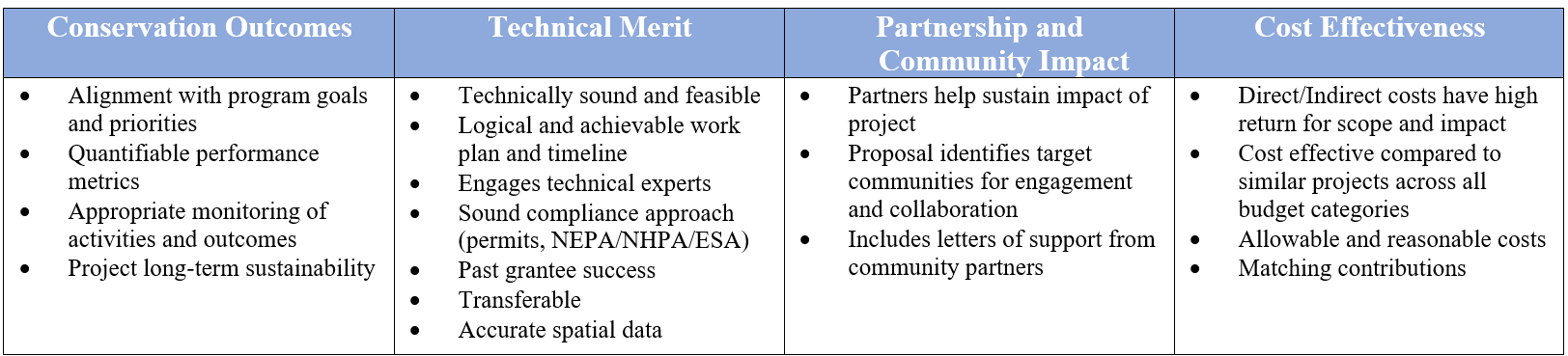
All proposals will be screened for relevance, accuracy, completeness and compliance with NFWF and funding source policies. Proposals will then be evaluated based on the extent to which they meet the following four evaluation criteria.
Spatial Data – Project spatial data submitted to NFWF’s online mapping tool accurately represent the location(s) of conservation activity(ies) at the time of proposal submission. Successful projects will be required to submit improved spatial data for each conservation activity within the period of performance as necessary. In 2026, all awarded DWCF applicants will be required to enter their proposed projects into FieldDoc following notification of award. During the application period, applicants are encouraged to utilize FieldDoc to calculate nutrient and sediment reductions. When setting up proposed projects in FieldDoc, please be sure to list your application’s 5-digit Easygrants number in the FieldDoc Pact name.
Free technical assistance will be available to grantees to ensure accurate tracking and reporting of applicable project activities during the grant project period of performance. For technical support on FieldDoc utilization during the proposal development process, please contact FieldDoc support through The Commons at support@fielddoc.org. Additional guidance is available at help.fielddoc.org.
Uniform Guidance - Federally-funded projects must be in compliance with OMB Uniform Guidance as applicable.
OTHER TERMS ASSOCIATED WITH A NFWF GRANT AWARD
Ineligible Uses of Grant Funds
- NFWF funds and matching contributions are strictly prohibited from being used for a number of reasons to include, for example, political advocacy, fundraising, lobbying, litigation, terrorist activities, or in violation of the Foreign Corrupt Practices Act. See OMB Uniform Guidance for additional information.
- Equipment: Applicants are encouraged to rent equipment where possible and cost-effective or use matching funds to make those purchases. NFWF acknowledges, however, that some projects may only be completed using NFWF funds to procure equipment. If this applies to your project, please contact the program staff listed in this RFP to discuss options.
- Federal funds and matching contributions may not be used to procure or obtain equipment, services, or systems (including entering into or renewing a contract) that uses telecommunications equipment or services produced by Huawei Technologies Company or ZTE Corporation (or any subsidiary or affiliate of such entities) as a substantial or essential component, or as critical technology of any system. Refer to Public Law 115-232, section 889 for additional information.
- Pursuant to the American Security Drone Act (ASDA), effective December 22, 2025, applicants proposing activities funded in whole or in part with federal funds may not use, operate, or purchase any drone or uncrewed aerial systems (UAS) included on the Covered Foreign Entities (CFE) List. This prohibition applies to both new purchases and continued use of existing UAS, including certain widely used commercial platforms, such as DJI and Autel. Applicants are responsible for ensuring that all proposed and existing UAS used in connection with federally funded activities comply with applicable federal law and are not included on the CFE List. Noncompliance may affect eligibility for funding.
- NFWF funds may not be used to support ongoing efforts to comply with legal requirements, including permit conditions, mitigation and settlement agreements. However, grant funds may be used to support projects that enhance or improve upon existing baseline compliance efforts.
Environmental Services – NFWF funds projects in pursuit of its mission to sustain, restore and enhance the nation's fish, wildlife, plants and habitats for current and future generations. NFWF recognizes that some benefits from projects may be of value with regards to credits on an environmental services market (such as a carbon credit market). NFWF does not participate in, facilitate, or manage an environmental services market nor does NFWF assert any claim on such credits.
Intellectual Property – Intellectual property created using NFWF awards may be copyrighted or otherwise legally protected by award recipients. NFWF may reserve the right to use, publish, and copy materials created under awards, including posting such material on NFWF’s website and featuring it in publications. NFWF may use project metrics and spatial data from awards to estimate societal benefits that result and to report these results to funding partners. These may include but are not limited to: habitat and species response, species connectivity, water quality, water quantity, risk of detrimental events (e.g., wildfire, floods), and carbon accounting (e.g., sequestration, avoided emissions).
Procurement – If the applicant chooses to specifically identify proposed Contractor(s) for Services, an award by NFWF to the applicant does not constitute NFWF’s express written authorization for the applicant to procure such specific services noncompetitively. When procuring goods and services, NFWF award recipients must follow documented procurement procedures which reflect applicable laws and regulations.
Publicity and Acknowledgement of Support – Award recipients will be required to grant NFWF the right and authority to publicize the project and NFWF’s financial support for the grant in press releases, publications and other public communications. Recipients may also be asked by NFWF to provide high-resolution (minimum 300 dpi) photographs depicting the project.
Receiving Award Funds – Award payments are primarily reimbursable. Projects may request funds for reimbursement at any time after completing a signed agreement with NFWF. A request of an advance of funds must be due to an imminent need of expenditure and must detail how the funds will be used and provide justification and a timeline for expected disbursement of these funds. Requests for monthly advances will not be considered.
Compliance Requirements – Projects selected will be subject to requirements under the National Environmental Policy Act (NEPA), Endangered Species Act (state and federal), and National Historic Preservation Act. Documentation of compliance with these regulations must be approved prior to initiating activities that disturb or alter habitat or other features of the project site(s). Applicants should budget time and resources to obtain the needed approvals. The compliance process should be executed in a timely manner and reimbursement for project activities, including non-construction activities, may be delayed until compliance requirements are complete. Applicants should budget time and resources to obtain the needed approvals. As may be applicable, successful applicants may be required to comply with additional Federal, state or local requirements and obtain all necessary permits and clearances. NFWF has made resources available to assist grantees in completing NEPA and other federal compliance. These resources include templates, contacts, and a NFWF-funded consultant available to review documentation and provide process guidance. Please see the Tip Sheet for more information. Current compliance standing for existing NFWF grants will be considered when reviewing and selecting new proposals.
Permits – Successful applicants will be required to provide sufficient documentation that the project expects to receive or has received all necessary permits and clearances to comply with any Federal, state or local requirements. Where projects involve work in the waters of the United States, NFWF strongly encourages applicants to conduct a permit pre-application meeting with the Army Corps of Engineers prior to submitting their proposal. In some cases, if a permit pre-application meeting has not been completed, NFWF may require successful applicants to complete such a meeting prior to grant award.
HOW TO APPLY
All application materials must be submitted online through NFWF’s Easygrants system by Thursday, March 26th, 11:59 PM, EST.
- Go to easygrants.nfwf.org to register in our Easygrants online system. New users to the system will be prompted to register before starting the application (if you already are a registered user, use your existing login). Enter your applicant information. Please disable the pop-up blocker on your internet browser prior to beginning the application process.
- Once on your homepage, click the “Apply for Funding” button and select this RFP’s “Funding Opportunity” from the list of options.
- Follow the instructions in Easygrants to complete your application. Once an application has been started, it may be saved and returned to at a later time for completion and submission.
APPLICATION ASSISTANCE
A Tip Sheet is available for quick reference while you are working through your application. This RFP document can be downloaded here.
Guidance and best practice documents have been pulled together to assist grantees in building a strong proposal:
Additional information to support the application process can be accessed on the NFWF website’s Applicant Information page.
For more information or questions about this RFP, please contact:
Erin Lewis – Program Director, Delaware River
(202) 595-2413
erin.lewis@nfwf.org
Evie Kraner – Program Manager, Delaware River
(202) 595-2651
evie.kraner@nfwf.org
Ragan Smith – Coordinator, Northeast Regional Programs
(202) 938-0625
ragan.smith@nfwf.org
For one-on-one guidance, sign up for a virtual proposal lab:
NFWF, in collaboration with the FWS, will be holding weekly virtual proposal labs for the 2026 RFP from January 29th through March 24th. The labs will provide a space and time where partners can share proposal ideas and receive coaching and constructive feedback. To reserve some time in the lab, please visit our Bookings page. We're excited to work hand-in-hand with our partners to make certain they get the support needed to develop competitive proposals, ensuring that the DWCF funds the most effective and innovative conservation activities in the Delaware River watershed. In 2026, applicants requesting $1M or more are required to meet with the DWCF team via a virtual proposal lab before submitting an application.
For issues or assistance with our online Easygrants system, please contact:
Easygrants Helpdesk
Email: Easygrants@nfwf.org
Voicemail: 202-595-2497
Hours: 9:00 am to 5:00 pm ET, Monday-Friday.
Include: your name, proposal ID #, e-mail address, phone number, program you are applying to, and a description of the issue.